Organizations dealing with technology decisions often engage outside expertise to guide them. The two types of outside expertise that are most commonly mentioned are digital transformation consulting services and IT consulting services. Although the two are similar, they deal with separate issues, function at various organizational levels, and yield different results.
Understanding the distinction matters because choosing the wrong type of engagement costs time and money. Advice on infrastructure optimization is insufficient for a company that has to completely restructure its operations. Similarly, a comprehensive organizational reform program is not necessary for an organization with a particular technological issue. Knowing what each form of consulting actually covers is the first step in determining the appropriate scope of engagement.
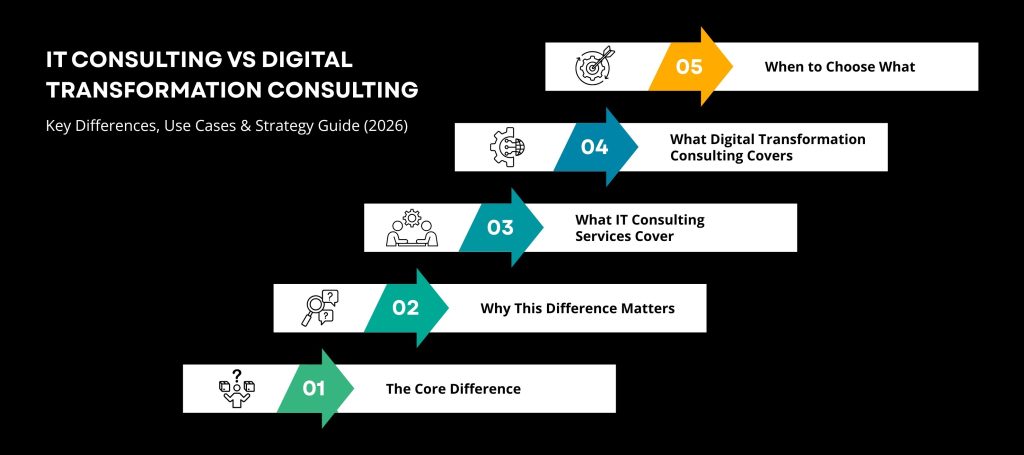
What IT Consulting Services Cover
IT consulting services concentrate on IT systems and infrastructure and IT operations. An IT consulting firm, in the context of such services, analyzes the current state of IT for an enterprise, recognizes the shortcomings or inefficiencies, and proposes appropriate technical solutions.
Consulting in information technology is defined by its scope, which can only go as far as technology. The consulting firm will take into account issues regarding systems development, integration, management, and security. What they will not deal with is organizational structure, decision-making, and process design within the company outside of technology.
Common areas covered under IT consulting services include:
Infrastructure and Architecture
IT consulting services in this area assess server environments; they involve analysis of server environments, cloud infrastructure, network structure, and data centers. The result will be the generation of suggestions regarding how the environment should be set up with regard to the performance, security, and cost considerations.
Key activities:
- Evaluate servers, cloud setups, networks, and data centers
- Identify performance, security, and cost gaps
- Recommend optimized infrastructure configurations
Relevant for organizations that:
- Are moving to the cloud
- Are consolidating data centers
- Need to upgrade legacy or end-of-life infrastructure
This is relevant for organizations that are moving workloads to the cloud, consolidating data centers, or upgrading on-premises infrastructure that has reached the end of its useful life.
Cybersecurity and Risk
Reasons organizations seek IT consultancy include conducting cybersecurity evaluations, managing vulnerabilities, preparing for compliance, and establishing security frameworks. The consultancy firm examines current controls, determines the extent of vulnerability, and provides advice on adjusting policies, tools, and procedures to minimize risk.
Key activities:
- Conduct cybersecurity assessments and vulnerability analysis
- Review existing controls and identify security gaps
- Design security frameworks and compliance strategies
- Recommend improvements to policies, tools, and processes
Focus:
- Specifically addresses technology-related threats and technical controls (not general business risk)
This is distinct from general risk consulting. The focus is specifically on technology-related threats and the technical controls that address them.
Systems Integration
If organizations are using several technology platforms that fail to interconnect efficiently, then the role of IT consulting is to offer technical skills in integrating these platforms through ERP implementation, middleware design, and API architecture.
Key activities:
- Design integration solutions for disconnected platforms
- Implement ERP systems and enterprise applications
- Develop middleware and API architectures
- Build data pipelines for smooth data flow
Focus:
- Ensures efficient communication and interoperability across multiple systems
IT Governance and Service Management
IT consulting services also cover how an organization manages its technology function internally. This covers vendor management structures, service management frameworks, IT operating model design, and IT performance evaluation. The result makes the internal IT department run more effectively and responsibly.
Key activities:
- Design IT operating models and organizational structure
- Implement service management frameworks (e.g., ITSM)
- Establish vendor management processes
- Define IT performance metrics and KPIs
Focus:
- Improves efficiency, accountability, and overall IT service delivery
Application Development and Management
Some IT consulting services companies offer guidance on the development, upkeep, and retirement of applications. This includes choices about development methodology, application lifecycle management, technology stack selection, and create versus buy.
Key activities:
- Advise on build vs. buy decisions
- Recommend technology stacks and architectures
- Define development methodologies (Agile, DevOps, etc.)
- Manage application lifecycle (build, maintain, retire)
Focus:
- Ensures applications are scalable, efficient, and aligned with business need
What Digital Transformation Consulting Services Cover
Digital transformation consultation services take on a much wider perspective compared to technology consultation services. In addition to technology-based systems, this includes the functioning of the business, serving its clients, and how the business performs in the marketplace.
The engagement of digital transformation consulting services begins by focusing on business results before anything else. In other words, the consultant determines the destination point of the client’s business, defines the barriers to success, and designs a strategy using various tools, including technologies, to bridge the gap.
Enterprise digital transformation consulting covers areas that IT consulting services typically do not, including.
Business Process Redesign
The digital transformation consultancy services analyze how tasks are performed in the organization and find out ways where these processes could be revamped for efficiency, saving costs, or better customer experience. The technology could come into play in achieving all of these; however, the process comes first, not the system.
Key priorities include:
- Diagnosing process inefficiencies, bottlenecks, and cost drivers
- Redesigning workflows to improve speed, quality, and scalability
- Simplifying cross-functional processes to enhance execution
- Embedding customer and employee experience into process design
The emphasis is on rethinking processes first—technology is an enabler, not the starting point.
Operating Model Change
Consulting in enterprise digital transformation usually entails structural changes to the organization. Such changes may include decisions on whether to go for centralization or decentralization, product-customer focus as opposed to functional focus, and who gets to make decisions at different levels of the organization.
Key priorities include:
- Redefining organizational structures and governance models
- Aligning teams around products, platforms, or customer journeys
- Clarifying decision rights and accountability frameworks
- Balancing centralization and decentralization for agility and control
This level of change extends beyond IT, reshaping how the enterprise operates at its core
.
Customer and Experience Strategy
Companies that are working toward digital transformation often consider the customer experience one of the central streams of their efforts. This includes customer engagement with an organization across various channels, the data collected by an organization from this engagement, and how the collected information can be used for improvements.
Key priorities include:
- Mapping end-to-end customer journeys across all touchpoints
- Leveraging data to understand behavior, needs, and preferences
- Designing seamless, omnichannel experiences
- Linking experience improvements to commercial outcomes
Customer experience is treated as a primary driver of growth, not a downstream outcome.
Data and Analytics Capability Building
Digital transformation consulting services involve developing the ability of the organization to harness data analytics in decision-making processes. This involves more than just having the technology infrastructure to store and process the data. It involves data governance structures, analytical capabilities within the organization, and decision-making based on insights gleaned from the data.
Key priorities include:
- Establishing robust data governance and ownership models
- Building advanced analytics and decision-support capabilities
- Integrating data into core business processes
- Enabling real-time, insight-driven decision-making
The focus shifts from data infrastructure to building a data-driven organization.
Change Management and Capability Development
Enterprise digital transformation consulting incorporates organized approaches to managing change because it entails changes in how people work. This includes leadership alignment, training initiatives, communication planning, and performance management adjustments that facilitate innovative working practices.
Key priorities include:
- Driving leadership alignment and sponsorship
- Designing structured communication and engagement strategies
- Building critical skills through targeted training programs
- Embedding new behaviors through performance and incentive systems
Unlike traditional IT programs, transformation efforts address the organizational and human dimensions required to sustain change.
For media and press enquiries, contact Anand Mishra at anand.mishra@inductusgroup.com
Business Transformation vs IT Strategy: Where They Diverge
An IT strategy defines how the company will invest in and organize its technology function over a certain time frame. Platforms, infrastructure, vendor partnerships, and the IT operational model are all covered. Designed to support the company plan, it is owned by the technology department.
Business transformation focuses on how an organization must adapt in order to meet its strategic goals. It addresses worker capability, organizational design, process architecture, and operational model. Technology is not the main topic, but rather one of its enablers.
A technological roadmap or technical suggestions are produced by IT consulting services. A program of change encompassing technology, process, organization, and people is produced by digital transformation consulting services. What distinguishes the two is the variation in scope.
Enterprise Digital Transformation Consulting: What It Involves in Practice
Enterprise-level digital transformation consulting services for large companies encompass strategic thinking, technology architecture, process design, organizational change, and program management, all carried out in parallel streams.
The engagement process starts with a diagnosis where the consulting company evaluates the current situation in terms of technology, processes, organizational dynamics, and business outcomes. This paves the way for developing a road map for the transformation project that prioritizes initiatives based on risk management and value delivery.
The implementation stage takes place based on the strategy outlined, with the consulting company working hand in hand with the organization’s internal teams and developing the necessary capabilities within the organization so that it can maintain the changes without the help of the consulting firm.
When to Engage IT Consulting Services
IT consultation is the way to go if there is a specific problem with technology at hand. Some examples of such problems include ERP system enhancements, cloud migrations, security audits, integration architecture design, and optimization of IT service management.
The scope is bounded. The organization knows what it needs to solve and the consulting firm delivers a defined technical output.
When to Engage Digital Transformation Consulting Services
Digital transformation consulting services are the right engagement when the organization is trying to change how it performs, not just how its systems are configured.
Organizations that have invested in technology without seeing the expected business results often need this type of engagement. The technology may already be in place, but the processes, structures, and capabilities needed to use it effectively have not kept pace.
Where the Two Overlap
IT consulting services and digital transformation consulting services are not mutually exclusive. Large transformation programs require both.
The distinction lies in the way the technology work is presented. In the case of a transformation project, technology-related issues take their place in a larger scheme of business results and change. During the strategic and design phases, digital transformation consulting services lead. During technical implementation, IT consulting services provide the specialist input.
Conclusion
IT consulting and digital transformation consulting have different functions and different levels at which they occur within an organization.
IT consulting focuses on technology-related systems, infrastructure, security, and processes. The limit here is set by technology. What comes out is a technological solution that will help enhance the performance of the IT function.
The digital transformation consultancy services relate to the operations and competitive approach of the firm. It involves technology, but it is not restricted to that; rather, it is concerned with process design, operating model changes, capability building, and change management. The result is a change management program delivering improvements in business performance.
Understanding business transformation vs IT strategy, and knowing which type of consulting engagement addresses each, allows organizations to structure their advisory relationships more effectively and get better value from the expertise they bring in.
As organizations try to determine their place along this continuum, the first step should be easy: does the issue stem from being a technical problem, or an organizational problem? This determination decides which kind of consulting project can achieve the desired results.