
A mid-sized manufacturing company is running five expansion projects at once: a new plant, an ERP rollout, two regional launches, and a compliance overhaul, and every one of them is being tracked in a different spreadsheet, by a different manager, with a different definition of done. Leadership knows they need outside help. The question is what kind. Should they hire a PMO consultant or a project management consultant? The two terms get used interchangeably in RFPs and LinkedIn posts, but they solve genuinely different problems, and picking the wrong one usually means paying for two engagements instead of one.
Understand Project Management Office (PMO)-Based Consulting
A Project Management Office, or PMO, is not a project team. It is the operating system every project inside a company runs on. It sets the templates, the reporting cadence, the risk framework, and the definition of success so that project number six does not reinvent what project number one already solved. PMO consulting services bring in outside specialists to design, build, or mature this office, rather than to run any one initiative.
Not every PMO looks the same. A supportive PMO offers templates and light coaching. A controlling PMO enforces process compliance across teams. A directive PMO goes further and actually runs projects on the business’s behalf. At the top sits the Enterprise PMO, or EPMO, which governs the entire portfolio at a strategic level, connecting every project back to company-wide priorities.
A PMO consultant typically builds the system fast, trains the internal team, then steps back so a permanent PMO leader can run what already works. A lighter version of this, a maturity assessment and roadmap without a full build, is usually sold as PMO advisory services.
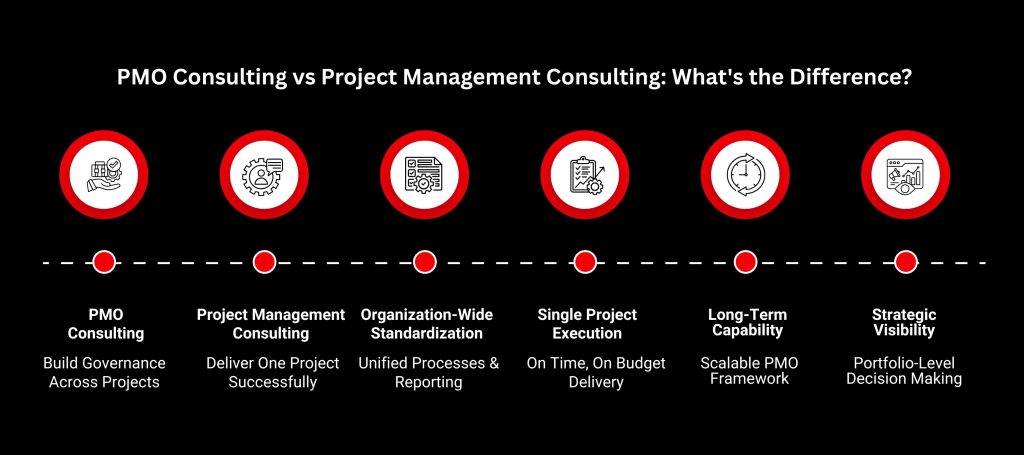
Table of Differences: PMO Consulting vs Project Management Consulting
On paper, PMO consulting and project management consulting sound like synonyms with different marketing spin. In practice, they diverge on almost every axis that matters to a business making a hiring decision.
Parameter | PMO Consulting | Project Management Consulting |
Scope | Organization-wide or portfolio-wide | One specific project |
Objective | Build lasting governance and capability | Deliver a defined outcome |
Duration | Ongoing, until the PMO reaches maturity | Bound to the project’s timeline |
Core deliverable | Governance frameworks, templates, dashboards, maturity roadmaps | Charter, schedule, budget, completed project |
Reports to | CXO or portfolio sponsor | Project sponsor or steering committee |
Success measured by | Adoption rate, standardization, portfolio ROI | On-time, on-budget, on-scope delivery |
What remains after the engagement | A functioning internal PMO | The completed deliverable itself |
Put simply, one builds the road system every future project will drive on. The other drives one truck to its destination and parks it.
What Type of Project Management Should Your Company Choose?
The right choice depends on what is actually broken.
If multiple projects are running with no shared process, no common reporting, and no consistent definition of success, that is not a resourcing gap; it is an infrastructure gap. PMO consulting fixes the infrastructure.
If there is one large, high-stakes, time-boxed initiative, an ERP rollout, a plant setup, or an M&A integration, the business needs expert hands actively delivering it, not a framework being built around it. That is project management consulting.
If the company is scaling fast across departments or geographies and leadership needs long-term visibility into how every initiative ties back to strategy, that is where strategic PMO consulting earns its place: portfolio governance, benefits tracking, and executive-level oversight, not just individual project success.
If budget and timeline are tight with no appetite for organizational change, a narrowly scoped project management consultant is the faster, cheaper route.
There is also a maturity path few companies talk about. Many organizations start with project management consulting to prove out one flagship delivery successfully, then use that credibility to justify building a permanent PMO. It is rarely either-or. It is a sequence.
Project-Based Example for Both Types
Consider a construction firm managing a multi-billion-rupee infrastructure expansion across dozens of contractors. Rather than stepping in to run any single contract, PMO consultants built a centralized project-control system and enforced one risk-management protocol across every workstream, so leadership could finally compare progress across the entire program on a single dashboard.
Contrast that with a telecom operator building one complex systems integration platform. Here, a project management consultant was brought in specifically to support the internal program manager, structuring the team, setting reporting cadence, and steering that one build to completion. Once the system went live, the engagement wound down too. Same industry, two different jobs.
Conclusion
PMO consulting builds the system your projects will run on. Project management consulting drives one project through to the finish line. They are not rivals. Most growing companies eventually need both, just at different points in their journey, often in exactly that order.