
A founder who hires a business consultant when they actually need a startup advisor doesn’t just waste a retainer; they lose the one resource early-stage companies can’t buy back: time. The two roles get used interchangeably across LinkedIn posts, founder forums, and even some accelerator materials, but a startup advisor and a business consultant run on fundamentally different models, one built on relationship and equity, the other on scope and fee. This blog breaks down what each role actually looks like in 2026, how to decide which one your startup needs right now, a side-by-side comparison, and a real-world scenario showing both roles in sequence.
Who Is an Actual Start-Up Advisor in 2026?
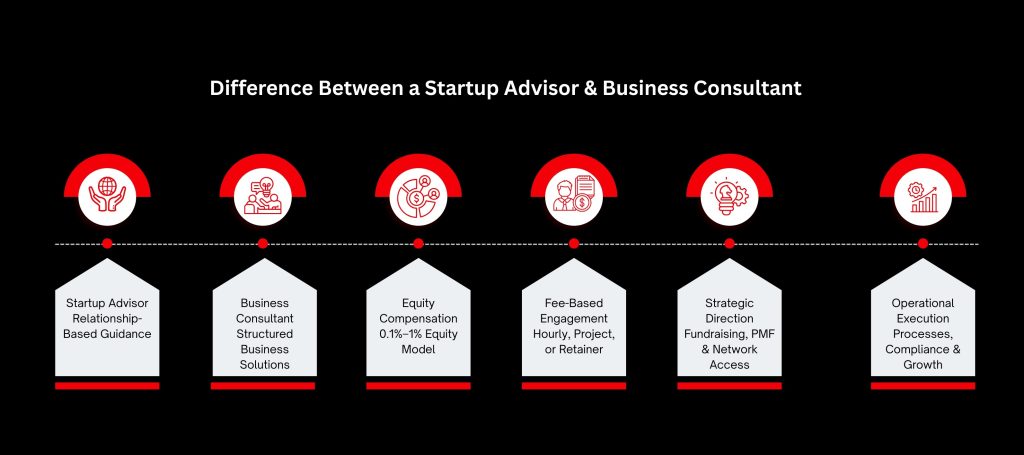
A startup advisor in 2026 is rarely a title on a business card; it’s a working relationship, usually with a former founder, operator, or ex-investor who has already navigated the stage a startup is currently in. Compensation typically runs through equity, commonly in the 0.1% to 1% range depending on involvement, rather than invoices. The scope is deliberately loose: fundraising narrative, investor introductions, hiring judgment calls, product-market fit sanity checks, and guidance that depends on pattern recognition rather than a fixed methodology.
What’s shifted recently is the formalization of a role that used to run on handshake deals. Advisor marketplaces have made sourcing easier, fractional-CXO arrangements now blur into advisory work, and most startups draft lightweight advisor agreements with vesting schedules and defined check-in cadences instead of leaving things undocumented. A pre-seed founder leaning on a startup advisor purely to sharpen a pitch narrative and open two warm investor introductions is a fairly typical 2026 engagement, a relationship, not a scoped project.
Who Are Actual Business Consultants in 2026?
A business consultant, by contrast, is engaged through structure. Engagements run on a defined scope of work, a timeline, and specific deliverables; a market entry plan; a restructuring roadmap; and a financial model, billed hourly, per project, or on retainer rather than through equity. The work sits in operations, process optimization, market entry, and financial strategy: problems that require a repeatable methodology rather than case-by-case judgment.
2026 has pushed the model further in two directions. AI-augmented diagnostic tools now compress what used to be multi-week discovery phases into days, and demand has shifted toward vertical-specific consultants, cross-border trade compliance, GCC market-entry strategy, and sector-specific regulatory navigation over generalists. The clearest way to separate this from advisory work: a business strategy consultant is accountable to a scope of work and a measurable outcome, while an advisor is accountable to a relationship and a set of judgment calls made over time.
Who Should I Choose for My Start-Up: Advisor vs. Consultant
Choosing between the two comes down to four questions, not a coin flip.
- Stage: Pre-seed and seed-stage startups solving for direction and access typically need an advisor. Startups’ past Series An optimizing execution typically needs a consultant.
- Problem type: Is the challenge relational and strategic, narrative, positioning, or introductory? That’s advisor territory. Is it operational and process-driven, a supply chain, financial restructuring, or compliance? That calls for business advisory services delivered through a structured consulting engagement.
- Budget structure: Equity available but limited cash points toward an advisor. Budget for fees, but no equity to spare points toward a consultant.
- Deliverable clarity: If the engagement needs a fixed timeline and a defined output, hire a business strategy consultant. If it needs ongoing, flexible judgment without a hard deliverable, an advisor fits better.
Run a startup through all four questions, and the right hire usually becomes obvious rather than debatable.
Table of Differences: Services, Roles, and Requirements
The differences are easiest to see side by side:
Parameter | Startup Advisor | Business Consultant |
Definition | Experienced operator offering informal, relationship-based guidance | Professional delivering structured business consulting services |
Primary Role | Strategic direction and network access | Operational execution and optimization |
Compensation Model | Equity-based (typically 0.1%–1%) | Fee-based: hourly, project, or retainer |
Engagement Duration | Ongoing and flexible | Fixed and scoped |
Typical Background | Former founder, operator, or investor | Domain specialist or firm-trained consultant |
Core Deliverables | Judgment calls, introductions, narrative input | Reports, roadmaps, frameworks |
Best Suited For | Pre-seed to seed-stage startups | Scaling or established businesses |
Level of Involvement | Periodic, relationship-driven | Structured, project-driven |
Accountability Structure | Relationship and trust | Scope of work and measurable KPIs |
Example Case Study
Consider a composite, realistic trajectory: an early-stage SaaS startup brings on a startup advisor at the pre-seed stage, a former founder with two prior exits, purely to sharpen its fundraising narrative and open doors to two relevant investor networks. Working off equity rather than a fee, the advisor helps compress the round timeline by roughly four weeks and strengthens the startup’s positioning ahead of investor meetings.
Eighteen months later, post-Series A, the same startup scales headcount from twelve to forty-five and starts hitting operational friction, inconsistent onboarding, inefficient reporting structures, and unclear financial controls. This is where the advisor’s skill set runs out. The founders bring in a business consultant on a three-month scoped engagement to redesign internal processes, build a financial reporting framework, and restructure reporting lines. The consultant delivers a fixed roadmap with measurable outcomes, something the advisor relationship was never built to produce.
Conclusion
The distinction, stripped down: a startup advisor provides direction; a business consultant provides execution. Choose based on your stage, your problem type, and what you can offer, equity or fees. As 2026 pushes more startups toward hybrid engagements that blend both roles by need rather than title, the smartest founders won’t ask which one sounds better; they’ll ask which business consultant or startup advisor actually solves the problem in front of them right now.