On a factory floor in Pune, a vision-guided camera catches a hairline crack in a metal casting three seconds before it reaches the packing line, no human inspector involved. Scenes like this are becoming ordinary, yet for most plant owners, the gap between watching AI work elsewhere and running it on their own line still feels enormous. They know automation is coming. What they don’t know is where to begin, which system to trust, or who should lead the transition. That is precisely where manufacturing AI consulting earns its place, turning ambition into a working production line.
Role of AI and Automation in Today’s World
AI and automation are no longer separate conversations on the shop floor; they work together, each handling a different layer of the job. Automation takes care of the repetitive: robotic arms welding identical joints, conveyor sensors triggering exact stop points, and machines running fixed sequences without fatigue. AI adds the adaptive layer above it, predictive maintenance systems reading vibration and temperature data to flag a bearing failure days before it happens, and computer vision cameras spotting surface defects a tired human eye might miss late in a shift. Add AI-driven demand forecasting, which studies past order patterns to help plants hold less idle inventory, and digital twins that simulate a new production layout before a single machine is physically moved. Together, this is what factory automation consulting increasingly means: pairing the muscle of automation with the judgment of AI.
Why is consulting a priority choice in the field of AI and tech?
Manufacturers know their machines intimately, the exact sound a motor makes before it fails, and the tolerance a die can handle before it wears. What they rarely have in-house is a data science team that can translate that shop-floor knowledge into a working algorithm. This is why AI implementation consulting has become less a luxury and more a necessity. Consultants bring something manufacturers can’t easily buy off a shelf: pattern recognition earned across dozens of plants, so they’ve already seen where an AI pilot stalls before it stalls at yours. Adoption isn’t a one-time software install; it touches legacy ERP systems, safety compliance, and how shop-floor workers learn to trust a machine’s recommendation. Many manufacturers get stuck in what’s often called pilot purgatory: a promising AI trial that never scales past one machine or one shift. Consultants exist to close exactly that gap.
How Manufacturing AI is a Priority for Industries
The urgency here isn’t abstract. Global competition is compressing margins, skilled technical labor is harder to find every year, and rising raw material costs make waste reduction non-negotiable. Different sectors are moving at different speeds: automotive plants have leaned into robotics and predictive maintenance for over a decade, while pharmaceutical manufacturing is only catching up now, held back by stricter validation and compliance requirements. Electronics and FMCG plants sit somewhere in between, adopting computer-vision quality checks quickly because defect tolerance there is razor-thin. India adds its own layer of urgency to this picture. With PLI schemes and the Make in India push pulling global supply chains toward Indian soil, manufacturers here have a genuine first-mover window. Smart manufacturing consulting today could define who leads a sector five years from now, not just who kept up.
Ways in which Consultants Guide Manufacturers to Adopt AI & Automation
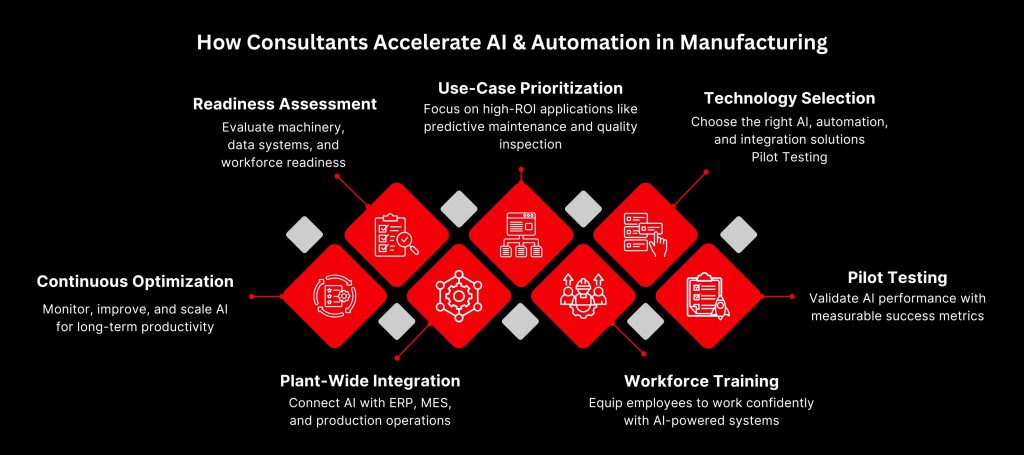
Adopting AI on a factory floor rarely happens in one leap. It moves in phases, each one building the trust and infrastructure the next phase needs. A consultant’s job is to sequence that journey correctly, resisting the temptation to chase the flashiest use case first, and instead starting wherever the fastest, most measurable win is hiding. The table below outlines how that phased journey typically unfolds, from the first plant walkthrough to a fully scaled, self-optimizing system.
Phase | What Consultants Do | Business Outcome |
Readiness Assessment | Audit existing machinery, data infrastructure, and workforce skill gaps | Clear baseline of what the plant can and can’t support yet |
Use-Case Prioritization | Identify which processes offer the fastest ROI, usually quality inspection or predictive maintenance | Momentum and stakeholder buy-in from an early, visible win |
Technology & Vendor Selection | Match the right AI/automation stack to plant size and budget | Avoids over-engineering and wasted capital spend |
Pilot Design & Testing | Run a contained pilot with clearly defined success metrics | Proof of value before committing to full rollout |
Workforce Training & Change Management | Upskill shop-floor teams to work alongside new systems | Prevents adoption from stalling at the human layer |
Scaling & Integration | Connect the pilot into existing ERP/MES systems, plant-wide | Consistent performance across the entire production line |
Continuous Optimization | Monitor and retrain models as production conditions shift | Sustained accuracy and ROI over the system’s lifetime |
Three of these phases tend to decide whether the whole initiative succeeds. Use-case prioritization matters because manufacturers who chase an ambitious, plant-wide AI rollout on day one almost always stall; starting narrow, with a single high-friction process, builds the internal confidence needed to scale later. Workforce training matters just as much, since even a technically flawless system fails if the people running the line don’t trust its recommendations. And AI integration services, connecting a successful pilot into a plant’s existing ERP and MES systems, is where most in-house attempts quietly break down, since legacy software was never built to talk to modern AI tools. Consultants who’ve solved that integration problem before are, in practice, the difference between a pilot that stays a pilot and one that becomes how the plant runs.
Inductus Limited: Your Go-To Place For AI-Automation Adoption & Tech Innovation
Inductus Limited, founded in 2007 and headquartered in Noida, Delhi NCR, has spent 17-plus years working across consulting & advisory, project management, and technology for more than 300 clients, including central and state governments, UN-affiliated organizations, and large Indian and multinational corporations. Its manufacturing plant and base setup practice already help companies establish and modernize production operations in India, built around PLI-scheme incentives and the country’s cost-competitive, skilled manufacturing base. That foundation makes AI and automation adoption a natural next layer rather than a leap: the same team that helps a manufacturer choose a plant site is positioned to guide the technology decisions that follow. Backed by a 1,500-plus professional team and ISO and CMMI-level certifications, Inductus brings the AI integration services manufacturers need to move from the plant floor to smart factories without starting from scratch.
Conclusion
Back on that factory floor in Pune, the camera that caught the crack didn’t replace the plant manager’s instinct; it gave that instinct better information, faster. That’s the real promise of AI and automation in manufacturing: not fewer people making decisions, but sharper ones. The manufacturers who lead the next decade won’t be the ones who adopted the most AI. They’ll be the ones who adopted it with the right guidance, at the right pace, which is exactly what the right manufacturing AI consulting partner is built to deliver.