Why Is Initial Start-up Strategy Building Important?
Most startups don’t fail because of a bad idea. They fail because the right moves happen in the wrong order, scaling a team before product-market fit is confirmed, spending on acquisition before retention data exists, or hiring senior leadership before there’s revenue to support it. A startup business strategy isn’t a forecasting document; it’s a sequencing discipline. It forces founders to decide, in advance, what year one is for and what gets deliberately postponed to year three. Without that discipline, every decision becomes reactive, made under pressure, with no reference point to check it against.
This matters beyond internal operations too. Investor due diligence has shifted: traction alone no longer carries a pitch. Investors increasingly look for evidence of structured strategic thinking, a roadmap, a financial model, and partnership logic because it signals a founder who can scale a decision-making process, not just a product. A documented 3-year business strategy is, in that sense, as much a credibility asset as a planning tool.
Guidelines for Early Business Start-Up Strategy
The five pillars below aren’t independent checkboxes; they’re interlocking. A roadmap without an execution rhythm stalls. A marketing plan without financial discipline burns cash with no return. Partnerships chosen without strategic fit become distractions rather than growth levers. Skipping any one of them is usually what separates a startup that compounds steadily over three years from one that spikes, stalls, and burns out.
Roadmap & Planning
A strong roadmap doesn’t try to do everything in month one; it sequences priorities across distinct phases. A workable structure looks like this: Year 1 is about validation and unit economics, proving the product solves a real problem at a cost that makes sense. Year 2 shifts to systemization, turning ad hoc wins into repeatable processes for acquisition. delivery, and retention. Year 3 is about scale and category positioning, expanding into adjacent markets or segments once the core engine is proven.
Execution Strategy
Planning and execution are often treated as the same thing in early-stage startups, but they’re not. A founder can have a precise three-year roadmap and still fail if there’s no operating rhythm behind it, weekly sprint reviews, a named owner for every milestone, and a hard discipline around saying no to scope creep in year one, when the temptation to chase every opportunity is highest.
Consider a startup with a genuinely well-built roadmap that nonetheless lost roughly six months in its first year, not because the plan was wrong, but because execution was reactive: priorities shifted weekly based on whichever problem felt loudest, with no review cadence forcing the team back to the original sequence.
Marketing & Advertising
Marketing in the first year of a startup should follow the maturity of the business, not run every channel simultaneously. Early-stage traction is usually best built through organic, community-led, and referral-driven channels, since they validate messaging and audience fit at low cost before any paid spend is justified. Paid acquisition becomes a sound investment only once CAC-to-LTV ratios are demonstrably healthy; scaling spend before that point usually just accelerates cash burn rather than growth. Brand positioning deserves the same long-view treatment. It should be built as a three-year asset.
Innovative Partnership
Strategic partnerships are one of the most underused growth levers available to early-stage startups, cheaper than paid acquisition and faster than building equivalent capability in-house. Co-marketing arrangements, channel partnerships, product integrations, and industry body affiliations can all accelerate market entry well beyond what a startup’s own resources would allow. This mirrors a pattern increasingly visible in the GCC and shared-services space, where organizations expand into new markets faster through ecosystem partnerships than through standalone expansion.
5-Year Financial Plans
It’s worth addressing directly why financial planning often extends a full two years beyond the strategic execution window: investors and lenders evaluate startups on longer-horizon unit economics and a credible path to break-even, even though the operational strategy itself is typically reviewed and reset every three years as market conditions shift. A 5-year financial plan functions as the underlying financial logic that a 3-year strategy operates inside of, not a contradiction of it.
A sound financial plan covers burn rate discipline, deliberate runway extension at key milestones, and revenue targets tied explicitly to each phase of the strategic roadmap, not generic year-over-year growth assumptions.
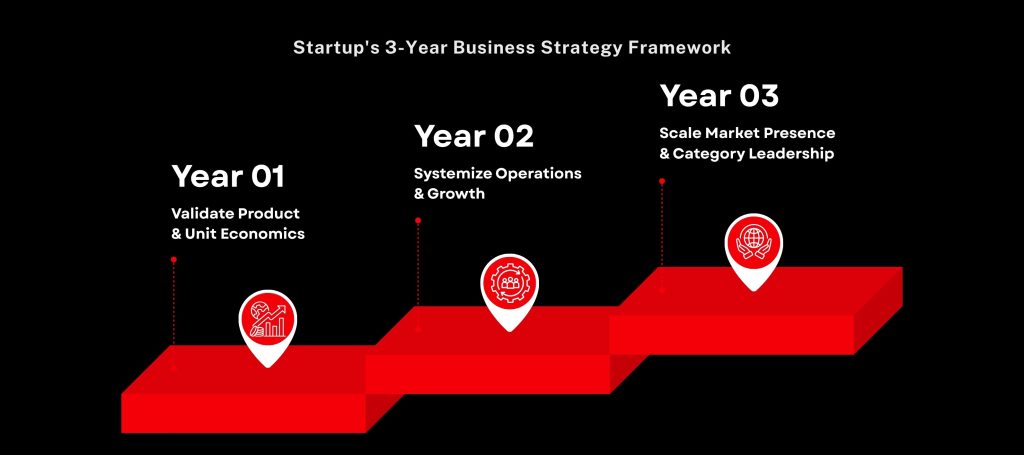
Table of Comparison: Early Planned, Strategized Start-Up vs. Spontaneous Burnt-Out Start-up
The difference between these two startup profiles rarely shows up in the idea itself; it shows up in how consistently each pillar above is applied versus skipped under pressure. The comparison below makes that gap concrete.
Strategic Area | Early Planned Start-Up | Spontaneous Burnt-Out Start-Up |
Roadmap Clarity | Phased, milestone-driven plan across 3 years | Vague long-term vision with no defined phases |
Execution Cadence | Weekly reviews, named owners per milestone | Ad hoc check-ins, priorities shift weekly |
Marketing Spend Timing | Organic-first, paid scaled after CAC:LTV proof | Paid spend front-loaded before validation |
Hiring Approach | Hiring tied to revenue and milestone triggers | Reactive hiring based on panic or pressure |
Partnership Strategy | Selected for long-term strategic fit | Pursued only for short-term lead generation |
Investor Readiness | Documented strategy and financial model on hand | Traction without a coherent strategic narrative |
Role of Business Consultants in Refining Start-Up 3-Year Strategy
Founders are often too close to their own business to see where the sequencing breaks down. This is typically where business consultants add the most value, not by supplying new ideas, but by catching blind spots in timelines and assumptions that feel obvious only in hindsight. A second, less invested perspective tends to surface the gap between what a founder believes is achievable in eighteen months and what the data actually supports.
The practical deliverables a good growth consultant brings are concrete: independent market sizing, competitor benchmarking that goes beyond surface-level comparison, and financial model stress-testing that pressure-tests assumptions before they’re presented to investors. The timing matters as much as the input itself. Startup growth consulting delivers the most value when brought in before year-one execution begins, shaping the strategy from the outset, rather than as a year-two rescue effort once cracks have already appeared.
Treated this way, external strategic input isn’t a one-time fix. It compounds across the full three-year window, refining the roadmap at each phase transition as real data replaces early assumptions.
Conclusion
A startup’s 3-year business strategy ultimately comes down to one distinction: founders who react to their business as problems surface and founders who direct it according to a sequence they chose in advance. The five pillars covered here, roadmap, execution, marketing, partnerships, and financial planning, aren’t separate initiatives. They’re one operating system, and skipping any single piece is usually what turns a promising start into a burnt-out one. Strategic planning isn’t a document a startup finalizes once and files away. It’s a discipline that gets revisited at every phase shift, which is exactly where a startup growth strategy, sharpened periodically through startup growth consulting, tends to outperform a plan that was only ever written once.