Architecting India’s Sunrise Era & the Epicentre of the $450B GCC Economy
Welcome to the Legacy of Inductus
On 21 November 2025, inside the Hyatt Regency in New Delhi, Inductus lit the lamp on something bigger than a single conference; it opened a new chapter in India’s Global Capability Centre story. That inaugural Global GCC Summit brought CXOs, policymakers, and global stakeholders together under one banner: Advantage India. The momentum didn’t stop at the closing remarks. Inductus followed through with the launch of “India Rising,” a first-of-its-kind research compendium charting the sector’s journey from 1985 to 2040, and sealed a cross-border MoU with Singapore’s Asteria Visions to extend India’s GCC capabilities into APAC, the Middle East, and Europe. Now, on 25 September 2026, at the same iconic venue, Inductus returns, sharper, bolder, and ready to architect the next phase of India’s sunrise era.
GCC 4.0 Evolution Strategy
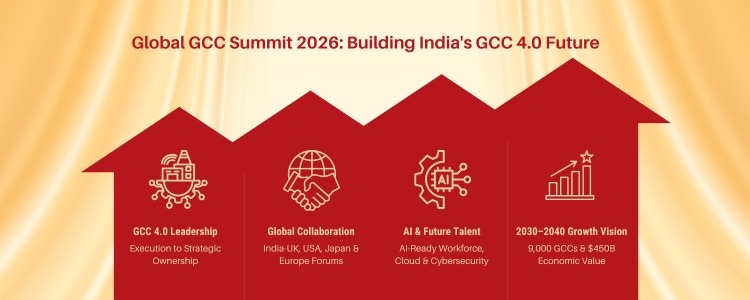
If Summit 2025 was about establishing India’s place on the map, Summit 2026 is about what comes after the map: ownership. Speakers at last year’s edition traced GCCs through four distinct eras: the cost arbitrage of the mid-80s pioneered by names like Texas Instruments and GE, the process arbitrage that centralized global operations, the knowledge arbitrage that handed India complex, high-skill work, and now, value arbitrage, where a GCC employee in India generates $37,000–$38,000 in per-capita value, on par with per-capita incomes in Japan and South Korea. GCC 4.0 marks the shift from execution to ownership, from following instructions to leading decisions. Summit 2026 builds its entire architecture around this shift, dedicating tracks to AI scaling, cloud infrastructure, and cybersecurity, the operational muscle GCC 4.0 demands. And if the boldest 2040 predictions hold, a 30-30-30 workforce split between core employees, AI agents, and “prosumers,” this summit isn’t previewing the future. It’s rehearsing it.
Areas of International Collaboration: Speaker Session
No summit claiming to be a “strategic command center” gets away with generic panels, and 2026 doesn’t try to. Four dedicated region-specific forums anchor the day: India-UK, unpacking business opportunities in the wake of the FTA through the Inductus-UKIBC Forum; India-Japan, uncovering synergies via the Inductus Forum; India-USA, harnessing bilateral business and investment landscapes; and India-Europe, catalyzing trade, investment, and GCC opportunities. Backing these conversations is serious institutional weight—industry associations, chambers of commerce, consulates, and embassies from key partner nations, all in the room. This isn’t networking dressed up as strategy. It’s where region-specific policy advocacy and cross-border GCC deals actually take shape, the kind of dialogue that turned a single MoU into an APAC-spanning partnership last year.
What’s new?
Summit 2025 opened the door. Summit 2026 walks through it with intent. Where the inaugural edition cast a wide net across GCC evolution broadly, 2026 sharpens its lens with dedicated, region-specific tracks for the US, the EU (including the UK), and Japan, prioritizing precision over breadth. New this year: The Global GCC Summit Awards 2026, recognizing the leaders and policymakers actually moving the needle. Also new: a spotlight on India’s states, their GCC-specific incentives, infrastructure bets, and policy pushes competing to become the next GCC magnet. The summit isn’t just documenting the sector’s scale-up. It’s scaling right alongside it.
Summit 2025 vs. Summit 2026
Picture Summit 2025 as the ribbon-cutting: a single grand opening day of keynotes and four landmark panels, GCCs Towards 2040; Digital Trust & DPDP Compliance; Talent Architecture for GCC 4.0; and The Innovation Imperative. It set the vision. Summit 2026, back at Hyatt Regency on 25 September, is where the vision gets built out, including region-specific forums, dedicated policy advocacy for GCC cities and single-window clearances, and an awards program to anchor accountability. The stakes have grown to match: India’s approximately 2,100 GCCs and 2.4 million professionals today are on a runway toward 9,000 centers, 8 million professionals, and $450 billion in economic value by 2040. A summit built for 2025’s ambition simply couldn’t carry 2026’s. This isn’t a sequel; it’s the next construction phase.
Skyrocketing to Global GCC Markets: Objectives & Orientation
From 2,100 centers today to a projected 9,000 by 2040, the summit’s objectives are built to match that trajectory, brick by brick.
- IT Infrastructure: The push for next-gen GCC ecosystems, GCC Cities, single-window clearances, and simplified tax frameworks is already live. GIFT City is targeting GCCs as its primary 2026 growth driver, while Maharashtra plans India’s first dedicated “GCC City” near Navi Mumbai airport.
- AI Enablement: GCCs are shedding their back-office identity for AI-led innovation status, moving from FTE-based to capability-based talent models, where AI fluency becomes baseline, not specialty, and Zero Trust cybersecurity becomes non-negotiable.
- Future-Ready Talent: The readiness gap is real; closing it needs a 10x–100x skilling scale-up, techno-functional professionals, and industry-academia models like the UK’s feeder-school approach, embedding real-world context into education from day one.
2030–2040 Action Plan Implementation: The roadmap is numeric and non-negotiable: 3,500 GCCs by 2030 and 9,000 by 2040, with GDP contribution climbing from 1.5% to 7.1%, with mid-market firms driving 80% of that expansion. The summit exists to turn that roadmap into working blueprints.
Conclusion
Mark the date: 25 September 2026, Hyatt Regency, New Delhi. This is where GCC ambition stops being a projection and starts becoming a plan, where practitioners convene to turn vision into execution. Register as a delegate. Apply as a speaker. Nominate the award. India’s sunrise era is here, and the $450 billion opportunity isn’t waiting in the wings; it’s waiting in the room.