Introduction: What are Global Capability Centers?
Companies are no longer just outsourcing work; they are building their own strategic outposts in India. Global Capability Centers (GCCs) are wholly-owned offshore units where multinationals run core functions like AI development, product engineering, analytics, and finance, staffed by their own people, not a vendor’s. A GCC gives a company full control over its talent, IP, and culture. That is why the shift from traditional outsourcing to captive center setup in India has become one of the defining business moves of this decade.
How Do Captive Centers Accelerate Growth & Innovation?
Think of a GCC less as a cost play and more as a second headquarters, one that runs leaner, scales faster, and taps into one of the world’s deepest talent pools.
NASSCOM projects India’s GCC sector to employ 2.8 million professionals and cross $110 billion in revenue by 2030, and the momentum is already visible. Inductus GCC’s annual report, cited by Forbes India, found that roughly 60% of the top 500 global companies already have GCCs in India. Over 70% are running AI-native workflows, and 45% of GCC leaders now participate directly in global C-suite decisions. This is no longer a back-office story.
Process to Set-Up GCC in India—
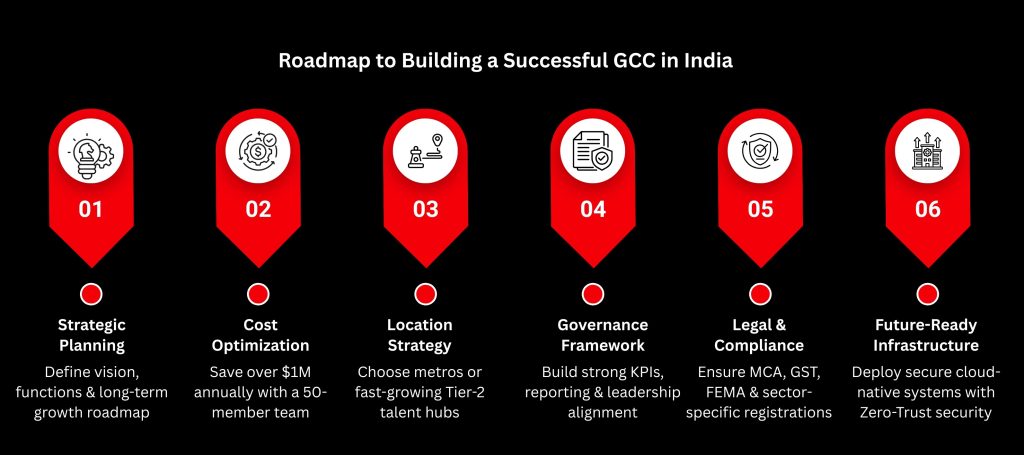
- Roadmapping to Success: Before leasing an office or posting a job, companies need a clear mandate, what the GCC will do, how it will grow, and what success looks like in three to five years. Skipping this is the most common and most expensive mistake in GCC business setup in India. Inductus GCC’s four-phase blueprint, Foundation, Integration & Testing, Talent Acquisition, and Operational Launch cuts the traditional 18-month setup timeline to 6–9 months by running legal, infrastructure, and technology workstreams simultaneously.
- Capital Building: India’s numbers are hard to argue with. For a team of 50 professionals, the all-in annual cost in India runs around $754,000 versus $1.86 million in the US, over $1 million saved each year. The Union Budget 2026-27 adds more: the safe harbor threshold is raised to ₹2,000 crore, the IT/ITeS margin is standardized at 15.5%, and a cloud tax holiday is extended to 2047.
- Geography Selection: City choice shapes everything: talent, attrition risk, and cost. Bengaluru hosts 40% of all GCCs and leads on AI and cloud engineering. Hyderabad is the go-to for life sciences, analytics, and BFSI, with 430+ centers. Pune offers strong product and engineering talent at 20–25% lower cost than Bengaluru. In 2026, Tier-2 cities like Coimbatore, Ahmedabad, and Kochi are growing 20% faster than metros, now accounting for 12% of GCC hiring, a compelling option for companies wanting quality without the metro price tag.
- Governance framework: A GCC without structure is just an office. Before go-live, companies need reporting lines, KPIs, escalation paths, and a clear link between Indian leadership and the global HQ. Building this from day one, not retrofitting it later, is what separates high-performing GCCs from expensive misfires.
- Legal Considerations: Most GCCs register as a private limited company under the Ministry of Corporate Affairs, which gives full operational flexibility. This means obtaining a PAN, TAN, and GST registration and staying compliant with FEMA for cross-border transactions. Entity structure has real tax and liability implications; getting this right early avoids headaches later.
- Certificates & verifications: Depending on the GCC’s function, companies need Shops & Establishment Act registration, professional tax registration, and an import-export code. Sector-specific clearances apply to CERT-In for cybersecurity, SEBI or IRDAI for financial services, and CDSCO for pharma operations.
- Infrastructure & IT: Office space, cloud platforms, cybersecurity architecture, and enterprise systems all need to be ready before the first hire walks in. With India’s GCC footprint expanding rapidly across all major cities, getting infrastructure right from day one is non-negotiable. Enablers like Inductus GCC deploy zero-trust security and cloud-native infrastructure from the outset, not as an afterthought.
- EXAMPLE Case Study: A mid-sized European tech firm partnering with Inductus GCC under the BOT (Build-Operate-Transfer) model went from intent to fully operational center in seven months, with 120 professionals across data engineering and product development up and running. Ownership transferred at month 24, with governance, IP protections, and performance benchmarks already embedded. The center now leads analytics mandates across three continents.
Roadblocks & Tackling Strategies—
Talent attrition in metro cities is real; the solution is Tier-2 expansion and internal talent academies. Regulatory complexity leads to delays when handled sequentially; a good enabler manages legal and compliance side by side. Geopolitical uncertainty in early 2026 slowed some GCC announcements, but the antidote is model flexibility, e.g., Inductus GCC’s COPO (Company-Owned-Partner-Operated) approach, which is expected to grow 25% in adoption by 2030.
How India Emerges as Leading GCC Ecosystem
India’s position is structural, not accidental. It produces more than 1.5 million engineering graduates a year, has the world’s largest pool of cybersecurity and data science talent outside the US, and represents 40% of the global GCC workforce. The sector is growing at 11–13% annually and is expected to reach $100–110 billion by 2030. The number of VP-level and above roles based out of India has increased 35%. Companies are not only setting up centers in India; they are also basing their decision-makers here.
Conclusion
Setting up a Global Capability Center in India in 2026 is one of the smartest moves a multinational can make, but only if done with the right structure. The roadmap, capital plan, city choice, legal entity, and governance all have to come together in the right sequence.
That is exactly where a specialist like Inductus GCC adds real value, not just handling the paperwork but ensuring the center is built to deliver from day one. India’s GCC ecosystem is wide open. The only question worth asking now is, “What is taking you so long to start?”