
A CFO staring at a spreadsheet showing three years of flat domestic growth doesn’t need another market-entry checklist. What they need is someone who has already navigated the regulatory maze, tax structuring, and partner ecosystem of the market they’re eyeing next. This is usually the moment a company realizes capital alone won’t carry an expansion forward; the right business expansion consulting firm will. Yet with dozens of firms promising end-to-end market entry support, few founders know how to separate genuine expertise from a polished pitch deck. This blog breaks down exactly how to evaluate and choose the right partner, not just why you need one.
Why & When Should Companies Expand?
Expansion isn’t a milestone you plan around a calendar; it’s a response to signals. A domestic market nearing saturation, where customer acquisition costs are climbing faster than revenue, is one such signal. So is inbound demand, where international clients are already buying informally through resellers or freelancers, indicating unmet appetite. Watching a competitor plant a flag first in an underpenetrated geography is another warning sign, since first-mover advantage compounds and catching up later costs more than moving early. Regulatory tailwinds matter too. A new free trade agreement or production-linked incentive scheme can shrink entry costs for a defined window. The World Bank’s Business Ready report, launched in 2024 as the successor to the discontinued Doing Business rankings, now benchmarks regulatory quality and public-service efficiency across dozens of economies, offering a useful lens for spotting where entry has genuinely gotten easier rather than just cheaper on paper. A credible business growth consulting firm helps translate these signals into a defensible entry thesis before capital moves.
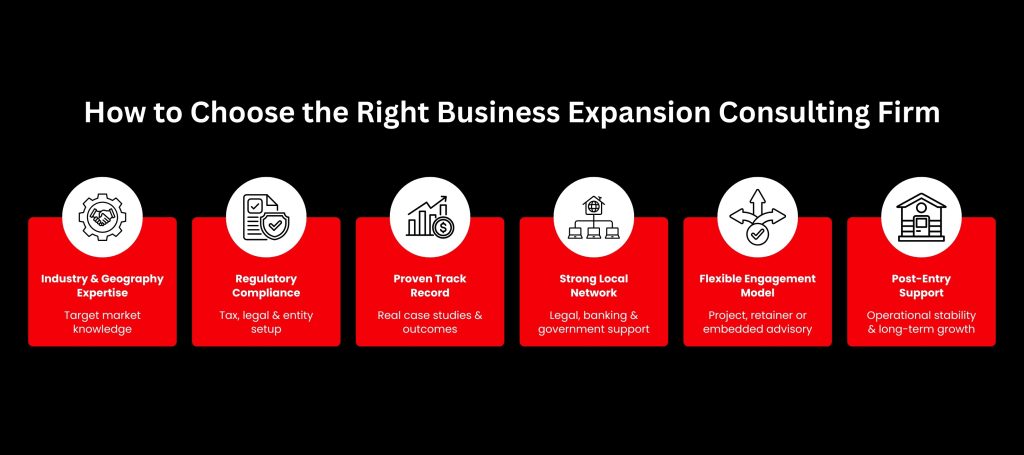
How Should I Choose the Right Business Expansion Consulting Firm for My Business?
Choosing a partner isn’t about credentials on a homepage; it’s about testing fit against six decision lenses.
Domain and Geography Expertise
Ask whether the firm has handled your specific industry in your specific target country, not just international experience in general. A firm that scaled a SaaS company into Southeast Asia may have little relevant play book for a manufacturing entity entering East Africa.
Regulatory and Compliance Fluency
Confirm whether they navigate local labor law, tax structuring, and entity incorporation directly or quietly outsource it to a third party you’ll never meet. Direct fluency shortens timelines and reduces liability.
Track Record and Case Evidence
Client logos prove little on their own. Ask for anonymized case studies with measurable outcomes, such as time-to-market or compliance issues avoided, rather than just a list of familiar company names.
On-Ground Network
Global business expansion consulting is only as strong as the local network behind it, including legal counsel, government liaisons, and banking relationships. A firm operating entirely remotely from your target market is worth questioning closely.
Engagement Model Flexibility
Project-based, retainer, or embedded advisory each suits a different expansion stage. Early feasibility work rarely needs a retainer, while post-entry stabilization often does.
Post-Entry Support
The best business expansion advisors don’t disappear once the entity is incorporated. They stay through operational stabilization, when most avoidable mistakes actually surface, so it’s worth asking directly where their engagement ends.
Together, these six lenses matter more than any single firm’s size or global footprint when it comes to actually predicting fit.
What Services Do Business Expansion Consulting Firms Offer?
Business expansion consulting services generally fall into three clusters, and understanding the shape of an engagement matters more than memorizing a service menu.
- The strategic cluster covers market entry feasibility studies, competitive landscape mapping, and go-to-market strategy, the analytical groundwork that determines whether entry makes sense at all. Companies often underestimate how much this phase alone can save by preventing a wrong-market bet before real capital is committed.
- The operational cluster covers entity incorporation, local hiring or employer-of-record setup, and vendor and supply chain onboarding, the unglamorous execution work that actually gets a company trading on the ground. Skipping proper operational scaffolding is where many expansions quietly stall.
- The compliance and risk cluster covers tax structuring, regulatory licensing, and cross-border data or IP compliance, arguably the highest-stakes cluster since failures here carry financial penalties and reputational damage long after entry. Global business expansion consulting firms that offer all three clusters under one roof reduce the coordination overhead of managing multiple vendors across time zones.
Role of Advisors in Business Expansion — Why Should You Get One?
The real value business expansion advisors bring isn’t execution speed; it’s pattern recognition. A firm that has guided dozens of companies through similar entries has already seen which mistakes recur, while an in-house team encountering this for the first time is essentially improvising with real capital on the line.
Documented cases make the cost of skipping this pattern recognition concrete. Case Study: Target’s 2013 entry into Canada, backed by more than four billion dollars of investment, unwound within two years after supply chain and pricing missteps that experienced local advisors would likely have flagged early. Walmart’s exit from Germany after roughly a decade, and Tesco’s costly withdrawal from the United States market, followed a similar pattern of strong domestic playbooks applied without enough local recalibration.
Advisors absorb this risk by translating ambiguity: an unfamiliar tax code, an unwritten negotiation norm, or a licensing requirement buried in local statute. That translation is often what separates an expensive mistake from a costly public retreat.
Conclusion
Choosing the right business expansion consulting firm ultimately comes down to one principle: fit over pedigree. A firm with an impressive global client roster is worth little if it lacks the specific market, industry, and stage-appropriate expertise your expansion actually needs. Run every prospective partner through the same lenses of domain depth, on-ground presence, engagement flexibility, and post-entry commitment before signing anything. Inductus works alongside growing companies precisely at this intersection, bringing the regional fluency and cross-border delivery experience that turns an expansion plan into a functioning operation on the ground.