
In 2026, the cost of building an in-house tech team has outpaced what most companies budgeted for even two years ago. Salaries for skilled developers keep climbing, AI-related roles are harder to fill than ever, and hiring cycles stretch from weeks into quarters. This is exactly why development consulting services have moved from a nice-to-have to a default strategy for companies that want to build fast without building alone. The real question isn’t whether to build in-house or outsource anymore. It’s whether your company can afford not to partner with the right development consulting service.
What is Outsource Development Consulting?
Outsource development consulting is often confused with plain IT outsourcing, but the two aren’t the same. IT outsourcing typically means handing off execution, writing code, testing, and deployment to an external team. Development consulting operates a layer above that: it’s strategic guidance on how, what, and when to build. A development consultant helps decide the right architecture, the right tech stack, and the right sequencing of a product roadmap before a single line of code is written.
Think of it like the difference between hiring an architect and hiring construction labor. One decides what should be built and how it should stand; the other builds it. IT development consulting services blend both, though the emphasis stays on direction, not just delivery. This model suits fast-scaling startups, enterprises modernizing legacy systems, and companies entering new markets without a local tech bench.
Table of Services Provided in Outsourcing Development Consulting
Development consulting engagements rarely look the same twice, but most cover a consistent set of services. Here’s how the scope typically breaks down:
Service | What It Covers |
Technology Strategy & Roadmapping | Defining the build sequence, prioritizing features, and aligning tech decisions with business goals |
Custom Software & Product Development | Building the actual product, module, or platform from specification through to release |
Digital Transformation Consulting | Guiding legacy-to-cloud migration, process digitization, and enterprise-wide tech adoption |
Legacy System Modernization | Re-architecting outdated systems without disrupting live operations |
QA & DevOps Consulting | Setting up testing pipelines, CI/CD, and release automation |
Staff Augmentation for Dev Teams | Embedding vetted developers into an existing in-house team on demand |
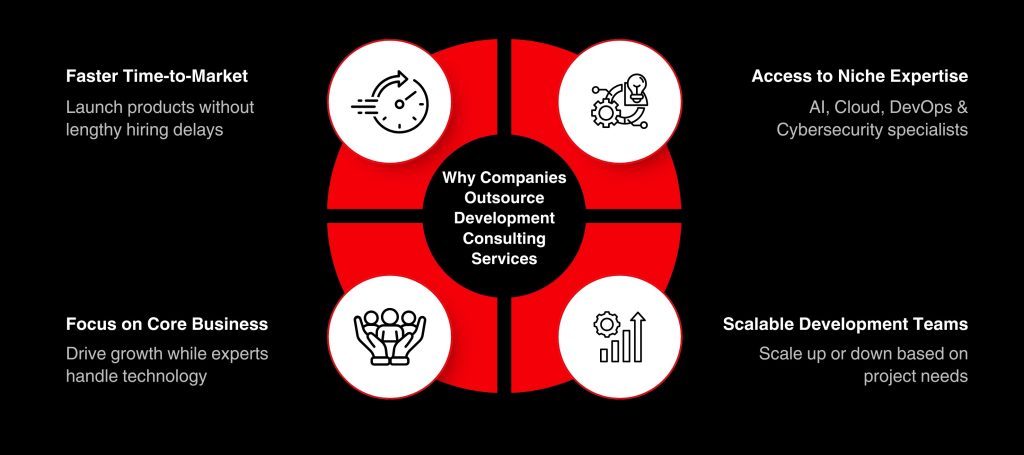
Why Do Companies Choose This Outsourcing Development Consulting?
So why are companies actively choosing this route instead of building every capability from scratch? The answer usually comes down to four practical pressures every growing business eventually runs into: speed, focus, expertise, and flexibility.
- Faster Time-to-Market. Hiring an in-house development team from scratch typically takes three to six months between sourcing, interviewing, and onboarding, time most companies simply don’t have. IT consulting outsourcing removes that bottleneck by plugging in pre-vetted expertise that’s ready to start immediately. In competitive spaces like fintech, SaaS, and healthtech, launch speed isn’t a convenience anymore; it’s a survival metric. A six-month head start can be the difference between capturing a market window and watching a competitor take it. Development consultants who’ve solved similar problems before also skip the trial-and-error phase that slows first-time in-house teams down.
- Focus on Core Competencies. Every hour a founder or tech lead spends debugging infrastructure is an hour not spent on product-market fit, sales, or customer retention. Consider a 20-person startup where the only technical hire is stuck firefighting server issues instead of shaping the product roadmap; that’s a direct opportunity cost, not just an inconvenience. Outsourcing development consulting shifts that operational weight off leadership’s plate entirely, freeing founders and internal teams to focus on what actually grows the business.
- Access to Niche Expertise. Some of the most in-demand technical skills today, AI/ML integration, cloud-native architecture, cybersecurity compliance, and API-first system design, take years to build internally and are expensive to hire for individually. A development consulting partner already has this bench strength in place. Instead of running a six-month search for one specialist, companies get immediate access to a team that’s already solved similar problems across other clients. Niche expertise bought on demand is almost always faster and cheaper than niche expertise built from zero.
- Scalability and Flexibility. Product development rarely moves at a constant pace; teams need to scale up sharply during a sprint or launch, then scale back down once the work stabilizes. Outsourced development consulting makes that elasticity possible without the legal and financial overhead of hiring and later downsizing. In a year shaped by unpredictable funding cycles and sudden demand spikes, this flexibility often keeps a company’s runway intact; consulting partners can flex team size within weeks, not quarters.
Conclusion: How Inductus is a Correct Choice for Outsourcing Development Consulting
Every advantage outlined above, speed, focus, expertise, and flexibility, depends on choosing the right partner, and this is where the track record matters. Inductus Group has spent 17+ years delivering technology-led consulting and outsourcing solutions from its base in Noida, Delhi NCR, working with 300+ clients that include government bodies, UN-linked development organizations, and global corporates.
Inductus IT, the group’s dedicated technology arm, focuses specifically on helping enterprises and startups stay competitive through digital innovation and custom-built solutions. For companies that need more than project-based help, Inductus’s Global Capability Center models, BOT, COPO, and Flexible, let businesses plug into ready-built development and consulting infrastructure instead of starting from zero. If your next build depends on getting the strategy right before the code gets written, it might be worth exploring what a software consulting company like Inductus could do differently.