In boardroom conversations and vendor pitches alike, “Global Business Services” and “Shared Services” are often used as if they mean the same thing. They don’t. Global Business Services (GBS) and Shared Services Centers (SSCs) are related, but they represent different stages of enterprise service maturity, distinct in scope, governance, and strategic intent. Understanding this distinction matters for any organization deciding how to structure its next delivery center. This article breaks down what each model actually is, where they overlap, and why India has become the ground of choice for both.
What is Actual Global Business Services (GBS)?
Global Business Services (GBS) is an enterprise-wide operating model that consolidates both back-office and front-office functions, finance, HR, IT, procurement, and customer-facing operations into a single, centrally governed structure. Unlike siloed function heads reporting independently, a mature GBS organization typically reports into one senior leader accountable for service delivery across the enterprise. Its purpose extends well beyond cost reduction: GBS is built to drive standardization, cross-functional collaboration, and technology-led value creation through automation, analytics, and increasingly, AI-enabled decision support. A multinational running its order-to-cash, HR helpdesk, and IT support through one unified governance layer, with shared KPIs and a single point of accountability, is operating a GBS model, not a traditional shared service. In essence, the Global Business Services model treats enterprise services as a strategic capability, not a support function.
What are actual Shared Services Centers (SSCs)?
Shared Services Centers (SSCs) predate GBS and remain its structural foundation. An SSC centralizes one function, or a narrow cluster of related functions, such as finance and HR, for multiple business units or regions, primarily to eliminate duplicated effort and reduce operating costs. Governance under the shared services model is typically function-specific: an HR SSC head manages HR delivery and a finance SSC head manages finance delivery, largely independent of one another. The focus stays operational and transactional, with payroll processing, accounts payable, and IT ticketing executed at scale with standardized processes and service-level agreements. This model has a long track record; organizations began adopting centralized shared services decades ago to consolidate regional back-office work. SSCs remain a resilient, trusted approach today, but on their own, they optimize efficiency within a function rather than across the enterprise.
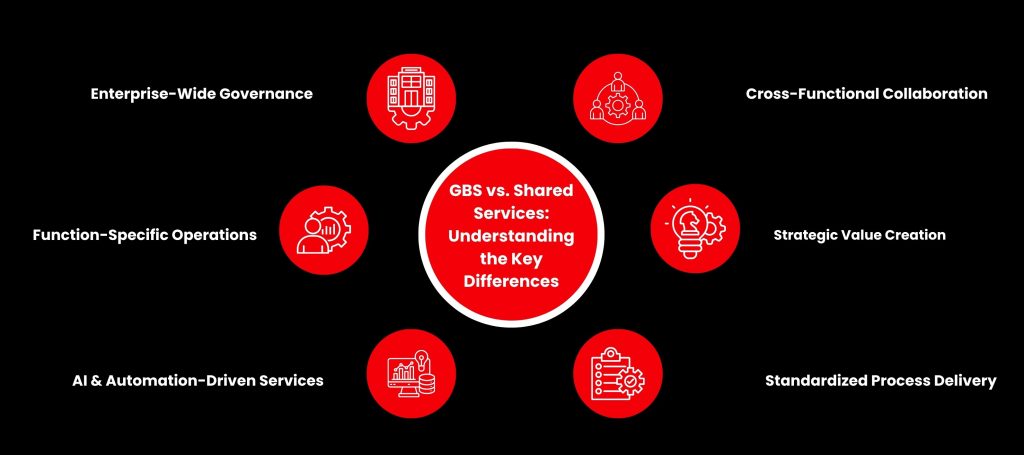
Table of Comparative Analysis: GBS vs. SSCs
Placed side by side, the structural differences in enterprise service delivery become clear. The table below compares the two models across the dimensions that matter most to business leaders evaluating either approach.
Parameter | Global Business Services (GBS) | Shared Services Centers (SSCs) |
Scope | Multi-functional, enterprise-wide | Single-function or narrow function cluster |
Governance | Unified, CXO-led leadership | Function-specific leadership |
Strategic Focus | Value creation, innovation, decision support | Cost control, redundancy elimination |
Technology Orientation | AI, automation, and analytics-driven | Process standardization-driven |
Maturity Stage | Advanced, evolved delivery model | Foundational delivery model |
Primary Objective | Enterprise agility and strategic alignment | Operational efficiency at function level |
In practice, GBS rarely replaces SSCs outright; it builds on them, integrating existing shared service functions into one strategic, cross-functional delivery engine.
List of Cross-Function Services Offered by GBS & SSCs
Both models often deliver overlapping functions. The real difference lies in how that delivery is structured and governed, not in what is delivered.
- Finance & Accounting (O2C, P2P, R2R): SSCs run these as discrete transactional processes; GBS integrates them into one unified finance delivery function.
- HR & Talent Operations: SSCs handle payroll and employee support; GBS extends this into workforce analytics and enterprise talent strategy.
- IT Helpdesk & Infrastructure Support: SSCs manage ticketing and resolution; GBS layers in automation and enterprise-wide digital governance.
- Procurement & Vendor Management: SSCs standardize purchasing; GBS aligns procurement with cross-functional, strategic sourcing decisions.
- Customer Experience & Support Operations: Increasingly folded into GBS as a front-office function, rarely part of traditional SSC scope.
- Data Analytics & Business Intelligence: A core differentiator, GBS actively builds this as a value-add service; SSCs rarely do.
- Compliance & Risk Management: SSCs mana
Why is India a Preferred Ground for GBS & SSCs?
India has moved beyond being a low-cost delivery location; it is now the operational and strategic hub for both the shared services model and the global business services model globally. As of FY2026, India hosts 2,117 Global Capability Centers across 3,728 units, generating $98.4 billion in revenue and employing 2.36 million professionals, according to the Nasscom GCC Value Orbit Report, a 32% jump in center count since FY2021. Notably, 506 Forbes Global 2000 companies now operate a GCC in India, alongside 583 mid-market and 504 private-equity-backed centers.
This scale is underpinned by deep STEM and AI talent pipelines, mature delivery hubs in Bengaluru, Hyderabad, Pune, Chennai, and the NCR, and fast-growing Tier-2 alternatives such as Coimbatore, Ahmedabad, and Indore offering 20–30% lower operating costs. Government policy is reinforcing this trajectory: the proposed National Policy on GCCs targets expansion to 5,000 centers and a $470–600 billion GDP contribution by FY30. The result is a shift in what India represents for enterprise service delivery. It is no longer just where organizations set up cost-saving SSCs; it is increasingly where GBS strategy, ownership, and enterprise decision-making itself are being headquartered.
Conclusion
So, is Global Business Services the same as Shared Services? No. SSCs are the operational foundation, function-specific, cost-driven, and transactional. GBS is the strategic evolution, enterprise-wide, technology-led, and value-focused. For organizations evaluating a delivery center in India, the real question isn’t GBS versus SSC; it’s which stage of this evolution matches their current operating maturity.