Summary
- What are end-to-end business solutions? End-to-end business solutions are integrated service offerings that manage every stage of a business process, from planning and implementation to support and optimization, enabling companies to streamline operations, reduce complexity, and focus on core competencies while minimizing capital expenditure and operational overhead.
- How do end-to-end business solutions benefit us? End-to-end solutions deliver measurable benefits including reduced time-to-market, 20–40% cost savings through economies of scale, improved risk management, 24/7 operational support, access to global expertise, seamless technology integration, and the ability to scale infrastructure without internal capital investment or resource constraints.
- What to look for in end-to-end business solutions? Evaluate end-to-end providers on domain expertise, proven track record with similar-scale clients, CMMI/ISO certifications, transparent SLA commitments, scalability across geographies, integrated technology stack, dedicated account management, and the ability to provide measurable KPIs tied to business outcomes rather than activity metrics.
- What are the top 3 services end-to-end solutions provide? Top services include (1) process optimization and business process outsourcing covering finance, HR, and supply chain operations; (2) technology infrastructure and digital transformation, including cloud migration, ERP implementation, and legacy system modernization; and (3) application development and managed services spanning custom software, technical support, and continuous improvement initiatives.
- Who is the best institute for end-to-end solutions in India? Leading end-to-end solution providers in India include established GCC operators and offshore service leaders such as INDUCTUS, headquartered in Delhi NCR; selection depends on industry fit (e.g., healthcare, fintech, and manufacturing), scale (startup to enterprise), and required expertise.
End-to-end Business Solutions: Facilitator of organisations
Most mid-market companies juggle five to seven service providers just to cover finance, IT, HR, procurement, cybersecurity, customer support, and supply chain. Every vendor piles on another contract, a new reporting style, a fresh SLA, and yet another layer of governance. The fallout? Fragmented operations. Accountability gets scattered, compliance slips through the cracks, and leaders end up wrangling vendors instead of driving the business forward. Research from NASSCOM says enterprise sourcing benchmarks all point to the same thing: more vendors mean more overhead, slower transformation, and less momentum.
That’s where end-to-end business solutions make a real difference.
They don’t just handle bits and pieces; they take full ownership of entire business capabilities. We’re talking about everything: strategy, execution, governance, optimization, analytics, and ongoing improvement. You stop dealing with a patchwork of providers and move to a single, integrated model with one team responsible for results. The payoff is real consolidation. You get one governance framework, one contract, one escalation path, and one strategic partner that’s tuned into your goals, not scattered across a bunch of disconnected tasks.
How an End-to-end Business Solutions Works in Realtime
Example-driven: Picture a manufacturing company gearing up to launch a fresh product lineup in six months, and at the same time, they’re expanding into two new countries. Big goals, tight timeline. They kick things off with a deep discovery phase. The provider comes in and gets hands-on: checking out how things work right now, spotting duplicate steps, mapping out bottlenecks, flagging technology gaps, and then putting together a clear roadmap. Leadership gets a plan that’s not just strategic but tied to real execution milestones.
When it’s go-time, a cross-functional team gets moving. You’ve got business consultants, solution architects, software devs, QA folks, infrastructure engineers, procurement pros, compliance specialists, and operations support all under one roof. Instead of the leadership juggling different vendors, they deal with one delivery partner. It keeps the project organized and cuts down on headaches. After everything rolls out, managed operations step in. Handoff protocols are standardized, there are 24/7 managed services, SLAs get tracked, governance reviews happen regularly, and support stays constant. Stability is the aim, and business disruptions stay minimal.
Finally, you hit the optimization stage. Every quarter, there’s a business review, checking productivity, seeing where automation fits, tracking costs, looking at resource use, and planning for scale. All this without going back over commercial terms. Companies end up dropping six or more vendor contacts, shrink deployment time by 30–40%, and actually achieve better operational synergy because real-time delivery is baked in.
Key Benefits of Using End-to-end Business Solutions
- Unified Project Management
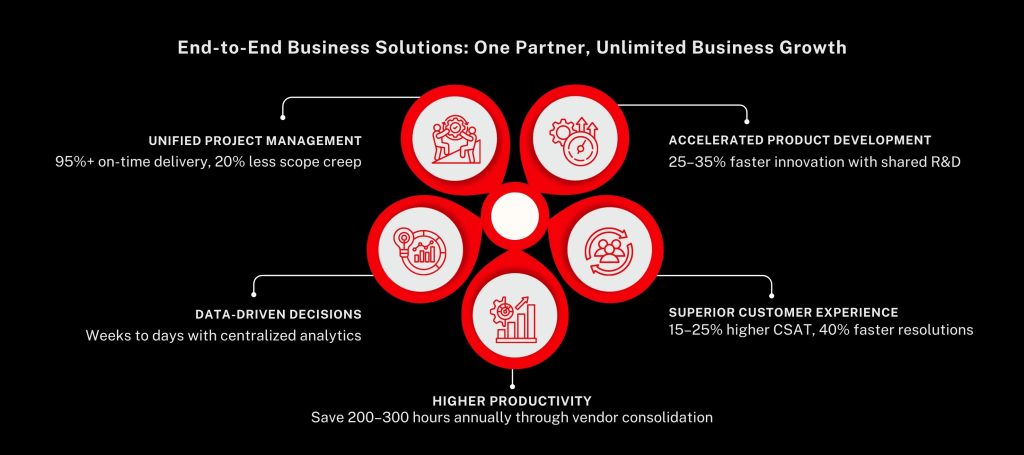
When you juggle multiple vendors, everyone’s too busy protecting themselves instead of working together. Developers point fingers at testers, infrastructure partners blame software teams, and no one’s really accountable. With a single end-to-end provider, all that finger-pointing disappears. You get unified project management, one PMO handling everything, real executive dashboards, centralized reporting, and a single path for escalation. One organization owns every milestone, risk, and quality gate. Decisions get faster, scope creep drops by about 20%, and projects actually cross the finish line on time, with a delivery rate over 95%.
- Accelerated Product Development & R&D
Innovation gets bogged down fast if you’re relying on just your internal R&D. The costs add up: hiring specialists, building labs, keeping up with compliance, and ongoing tech investments.
End-to-end providers change that game. You tap into shared innovation labs, secure engineering setups, global research talent, and rapid prototyping. You don’t need to keep expensive resources idle; just use what you need when you need it. For companies in hardware, deep tech, healthcare, or industrial sectors, that means product cycles speed up by 25–35%. Offshore and global centers, especially in India and Eastern Europe, bring in engineering muscle without locking you into long-term costs.
- Enterprise Data Analysis & Management
Most companies are drowning in data but starving for insights. Departments like finance, sales, ops, and service all have their own spreadsheets, and executives can’t get a clear picture. An end-to-end provider fixes this, centralizing all your data, automating ETL, building robust data lakes, managing governance, and delivering BI automation. Suddenly, you’ve got real-time insights at your fingertips instead of waiting weeks. Global Capability Centers are now enterprise analytics engines, scaling up analysis and boosting data governance. The payoff? Insights that used to take weeks now arrive in just a few days.
- Superior Customer Experience
Customer service falls apart when split between different vendors. Customers repeat themselves, cases bounce around, and support loses consistency. A single provider takes over the entire customer journey, across phone, email, chat, and self-service. With AI-driven routing, integrated CRM, and unified customer history, everything runs smoother. Continuous feedback analytics spot where things can improve. Companies using AI-powered support see satisfaction climb by 15–25%, and resolution times drop by nearly 40%. The result? Happier customers who actually stick around.
- Time Savings & Productivity Maximization
Managing vendors quietly eats up a ton of time: weekly coordination calls, reviewing contracts, chasing invoices, and handling escalations. Every extra vendor means more admin.
Studies show each vendor costs your team 5–8 hours a week just in overhead. Consolidate with a single provider, and you’re down to one agreement, one SLA, uniform reporting, and a dedicated leadership team. Suddenly, you cut administrative effort by over 60%, freeing up 200–300 hours a year. Now your teams can focus on big moves, instead of endless coordination. Of course, real operational efficiency depends on great governance. That’s what turns short-term gains into long-term value.
Ways to minimize risks and maximize Profits
End-to-end consolidation reduces operational complexity but introduces new issues such as dependence on the vendor, data aggregation, pricing power, and business continuity when responsibility is centralized with a single provider. Good companies manage those risks with governance structures that provide an appropriate balance of flexibility and accountability. When you build commercial safeguards from the outset, you create long-term strategic partners, not transactional relationships.
Risk Category | Mitigation Strategy | Profit Impact |
Vendor lock-in / Switching costs | Escrow arrangements, modular SLAs, IP ownership clauses, 90-day exit protocols | Enables negotiation of 5–10% annual commercial improvements by reducing forced renewals |
Data security & Compliance Drift | SOC 2 and ISO 27001 audits, quarterly penetration testing, transparent breach-response SLAs | Reduces regulatory exposure and protects enterprise valuation during acquisitions |
Performance degradation | Outcome-based SLAs tied directly to KPIs, penalty clauses, quarterly executive governance reviews | Creates continuous performance improvement while recovering underperformance costs |
Talent retention at provider | Key-person clauses, six-month continuity commitments, structured knowledge transfer | Prevents operational disruption and minimizes expensive rework |
Inflation & Cost Escalation | Three-to-five-year pricing commitments with productivity-based escalation mechanisms | Limits annual cost growth to approximately 2–3% compared with higher market inflation |
Conclusion: Time to Choose End-to-end Business Solutions
The biggest benefit of end-to-end business solutions is not just lower operating costs; it’s unified accountability. A single, integrated delivery model provides organizations with stronger project governance, faster product development, enterprise-wide data intelligence, better customer experiences, and significantly higher operational productivity. The question has shifted from “Is integrated service delivery a good support for digital transformation strategy” to “How do we best structure end-to-end partner selection to maximize the ROI of managed services?”