
Most Indian startups don’t fail because the idea was wrong. They fail because they scale before building the operational backbone to support growth or because they move too cautiously and miss a once-in-a-lifetime market window. A business growth consulting firm exists precisely in that gap, the missing infrastructure layer between a promising idea and a company built to scale. Not every consulting firm fits a startup’s speed or budget, though. This piece breaks down what separates the right growth partner from the wrong one and why, for a growing number of founders, that partner is Inductus.
Understanding Growth Consulting Firms
A growth consulting firm isn’t a startup mentor offering general advice or a traditional consultant who audits a business and hands over a report. It gets embedded in execution, building the strategic and operational scaffolding a company needs to expand. In practice, that work spans four areas:
- Strategic & Market-Entry Planning—deciding which markets or segments are worth entering first and how.
- Operational Scaling — building the processes and systems that let a company grow without breaking.
- Technology & Process Consulting — implementing tools that remove manual bottlenecks.
- Global Expansion Support—GCC (Global Capability Center) and ODC (offshore development center) models that let a company operate abroad without owning the infrastructure outright.
Together, this is what’s usually meant by business growth consulting services: less advice, more delivery.
Why Startups Look for Growth Consulting Firms
Founders don’t bring in a growth consulting firm for lack of ambition; they do it because certain gaps are structural. The recurring reasons behind startup growth consulting engagements:
- No internal team to build a go-to-market plan for a second city or country, work that most early teams aren’t staffed for.
- Investor pressure for fast, defensible growth — boards want traction that holds up under scrutiny.
- Capital efficiency — an early-stage company can’t absorb a six-month misstep the way a larger enterprise can.
- Regulatory and market-entry complexity — a new geography brings compliance questions founders haven’t navigated before.
- Limited networks — access to talent or government relationships that normally take years to build.
It’s rarely about needing “guidance” in the abstract. It’s a nameable gap, like having no one in-house who can structure a GTM plan for a second market.
Inductus as India’s Leading Growth Consulting Firm
Inductus has operated since 2007, headquartered in Noida, Delhi NCR, and has spent 17+ years serving 300+ clients, spanning Indian and state governments, UN-affiliated organizations, and Indian and multinational corporates. The firm runs a 1,500+ strong professional team, holds ISO and CMMI-level certifications, and has been recognized with the Rajiv Gandhi Shiromani Award and the National Achievement Award for Business Excellence. Its footprint spans India, the US, and Europe (Luxembourg)—a partner with actual operating presence abroad, not just distant advisory reach.
That matters: per Forbes India, roughly 60% of the top 500 global companies have already set up Global Capability Centers in India, and Inductus GCC positions itself as an enabler inside that trend.
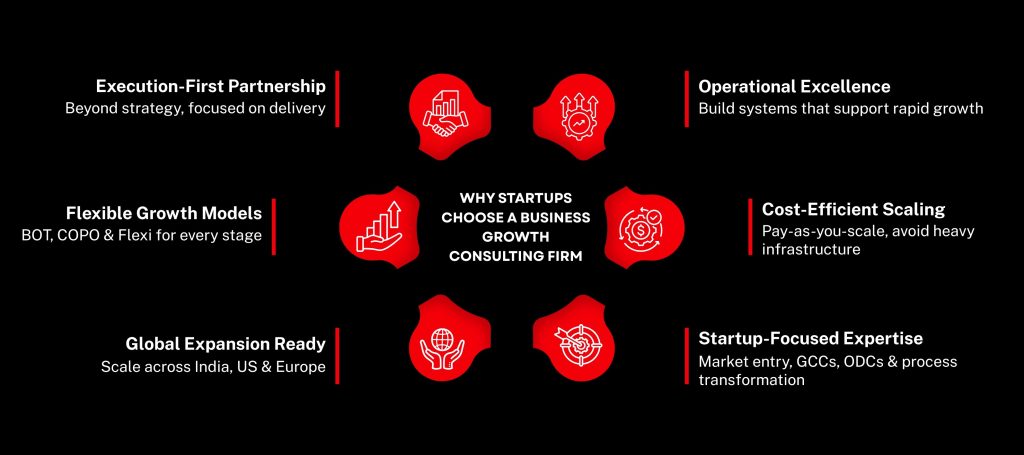
More relevant for a startup is how Inductus structures delivery—through the BOT (build-operate-transfer), COPO (company-owned partner-operated), and Flexi models. These let a young company scale operations, including offshore ones, without owning full infrastructure from day one, a different startup business growth strategy than the standard advisory retainer.
Which Firm Is Best for Startups?
Startups and large enterprises don’t need the same thing from a consulting partner. A startup typically needs leaner cost structures, faster decisions, and hands-on execution, not a slide deck followed by an invoice for advisory hours.
Parameter | What Startups Need | Large / Big-4 Firms | Inductus’s Approach |
Cost & flexibility | Pay-as-you-scale | High fixed fees, long contracts | Flexi/COPO models scale cost with growth |
Early-stage fit | Tailored, not templated | Standardized frameworks | Model chosen per stage: BOT, COPO, or Flexi |
Sector breadth | Advice grounded in real context | Broad but generalist | Government, UN-affiliated, corporate work |
GCC/ODC capability | Operate abroad, asset-light | Advisory only, rarely operational | Runs GCC/ODC delivery from India, the US, and Europe |
Execution vs. advisory | An execution partner | Mostly advisory | Embedded delivery, 300+ engagements |
For most founders, the deciding factor isn’t the logo on the deck; it’s whether the firm is still in the room after the strategy is signed off.
It’s Time for Startups to Choose Inductus
Seventeen-plus years of experience isn’t the same as years of PowerPoint decks; it’s 300+ client engagements across governments, UN-affiliated bodies, and corporations, delivered by a 1,500+ person team. That track record sits behind the BOT, COPO, and Flexi models: frameworks built so a startup can scale operations, including offshore ones, without the fixed cost of doing it alone. With a footprint across India, the US, and Europe, Inductus also suits founders planning international expansion, not just local growth.
That combination, delivery experience, flexible operating models, and genuine global reach are what startup expansion services should look like: not a strategy document handed off at the end, but a partner who stays through execution. The real choice isn’t whether to get outside help. It’s a choice between picking a firm that advises from the sidelines or one that scales alongside you.
Conclusion
The best business growth consulting firm for a startup was never going to be the biggest name on the pitch deck. It’s the one offering a cost-efficient, hands-on, execution-first partnership with genuine global reach, and on that measure, Inductus’s 17+ year track record, its BOT/COPO/flexi models, and its India-US-Europe footprint set it apart from generalist advisory shops.
India’s GCC and startup ecosystem keep expanding; more global companies are setting up capability centers here, and more Indian founders are looking to expand outward. That opportunity favors founders who pick the right partner early, not the biggest name on paper. If that’s where you are, it’s worth a real conversation with Inductus before your next funding round forces the decision for you.