The 21st century has become the defining era of entrepreneurship. Digitalization has lowered entry barriers, enabling startups to emerge across industries ranging from technology and manufacturing to healthcare, logistics, and professional services. At the same time, rapid advancements in artificial intelligence, automation, shared services centers, digital consulting, and global business ecosystems have increased operational complexity. Founders today are expected to scale faster, enter international markets earlier, and compete against established players with limited resources. This is where professional startup consultant services have become indispensable. A startup consultant helps founders transform ambitious ideas into scalable business models while avoiding costly mistakes that can hinder growth.
What is an actual startup consultant?
A consultant’s supposed to be an expert who gives unbiased advice to help businesses solve tough problems. But at startups, consultants don’t just talk; they roll up their sleeves and jump right in implementing. They help founders spot new ways to grow, set up practical systems, map out how to enter new markets, build partnerships, and push projects across the finish line.
Consulting has exploded in recent years, thanks to the messiness of modern business, loads of digital change, and the spread of companies across the globe. Firms in this space run on valuable know-how, making the industry pretty lucrative and opening doors for any business serious about getting reliable guidance. For startups, consultants are more than advisers; they’re catalysts. They clear the fog and boost the odds of building something solid that lasts.
Advisor Vs. Startup Consultant
Understanding the distinction between a startup advisor and a startup consultant is critical for founders.
1. Strategic Guidance vs. Execution
- Advisors primarily offer recommendations based on experience.
- Consultants provide recommendations and actively participate in implementation.
2. Long-Term Relationship vs. Defined Engagement
- Advisors often maintain an ongoing mentoring relationship.
- Consultants work on specific objectives, milestones, and business outcomes.
3. Network Access vs. Operational Capability
- Advisors contribute industry connections and insights.
- Consultants bring structured methodologies, specialized teams, and execution frameworks.
4. Opinion-Based vs. Data-Driven Solutions
- Advisors rely heavily on personal experience.
- Consultants leverage market research, analytics, benchmarks, and operational expertise to deliver measurable results.
For founders seeking rapid scaling, market expansion, or operational transformation, startup consultant services often provide a more comprehensive solution.
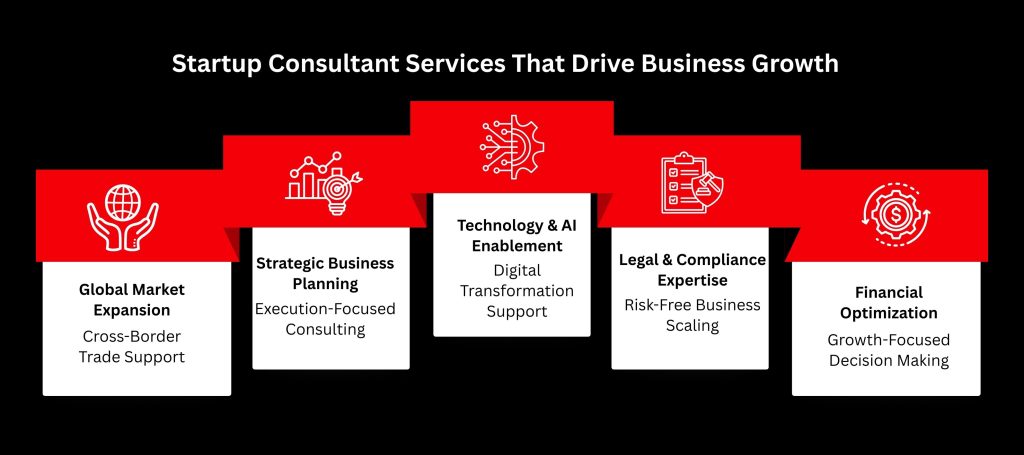
Key Services Offered by Startup Consultant
- International Trading
Global trade stands out as a huge growth opportunity for startups. Startup consultants jump in to help businesses launch both offshore and onshore trading, find suppliers they can actually trust, and figure out import-export regulations that would otherwise slow things down. They build out logistics networks that make sense and handle all the details around international sourcing. It doesn’t matter if you’re trading raw materials, grains, industrial parts, or finished products; consultants offer the real-world market know-how and practical compliance tools you’ll need for cross-border deals. With their help, startups manage risk better, run tighter supply chains, and break into lucrative international markets they wouldn’t reach alone.
- Marketing Media & PR:
Advertising in the 21st century is not at par when you’re looking for global growth. To build a renowned brand on the world stage requires strategy in fields like public relations, marketing, and even social media management. Startup consultants help companies with the full package, from integrated marketing, branding, media outreach, and public relations to earning respect and getting cross-border connections. They roll out targeted campaigns, digital pushes, smart content, and reputation management that actually puts companies on the map. Their work helps businesses move from unknown locals to respected global brands. Plus, strong media and PR attracts investors, draws in new customers, sparks key partnerships, and creates the momentum startups need to scale quickly.
- Tech & IT:
Technology keeps companies running. These days, it’s not just about having computers in the office; startups lean on AI, automation, cloud tools, and endless data just to stay in the game. Standing still isn’t an option. That’s where consultants come in. They figure out what’s working, what isn’t, and what’s missing. They recommend smarter, more adaptable IT setups, bring in automation, boost security, and cut out digital clutter. Their work goes beyond basic tech support; they handle software partnerships, shape SEO plans, and build out AI strategies. The goal is to make technology push the business forward, not just keep the lights on.
- Legal Regulations:
Compliance isn’t some quick box to tick; it’s a real challenge for every business that wants to grow. Startup consultants help companies navigate all kinds of complicated laws, both local and international, so they’re not blindsided and can keep moving fast. These experts handle the nuts and bolts: forming the company, drafting contracts, setting up solid governance, handling intellectual property, figuring out risks, and offering legal advice that actually makes sense. When a startup goes global, consultants break down the confusing rules between jurisdictions and guide them through every regulatory step. That way, the business doesn’t get tangled up in red tape and can focus on building momentum.
- Financial Services:
It is quite difficult to maintain up-to-date financial records when you already have a lot in the background. Consultants shore up accounting, build out planning, optimize tax and payroll, and support everything from budgets to raising capital. They go past the basics; consultants help founders map out smart growth, protect margins, prioritize spending, and prep for future funding. With finance locked in, startups make better calls and stay tough, even when chasing big growth or navigating unpredictable markets.
Who Should Reach Out for Startup Consultants?
Startup consultants aren’t just for early-stage ventures; they’re a secret weapon for any organization aiming to shake things up or scale. Think government agencies, public sector undertakings, big project management firms, multinationals, and even the heavyweights behind international development projects. Whether it’s a United Nations-backed initiative in India or a private company building a new Global Capability Center, these organizations get a real edge by bringing in outside expertise. Consultants help them set up frameworks that actually scale, tighten up governance, fast-track big projects, and spot new chances for growth. If you want to expand, boost operations, break into global markets, or pull off a major transformation, you need experienced startup consultants on your side not as an afterthought, but as a core part of your strategy.
Conclusion
The startup scene moves quickly towards innovation, incorporating strategy . If you want to win, you need quick decisions, fresh ideas, and a clear strategy, and honestly, pulling that off takes expert guidance. A smart startup strategy isn’t just a nice bonus; it’s what decides if your project turns into a thriving business or just fizzles out. That’s where Inductus Limited comes in. They’ve built a reputation as the best startup consultants, really going all in on business transformation, global reach, and fueling growth with innovation. Alouk Kumar, their CEO, sums it up well:
At Inductus, we stand at this crossroads of opportunity, empowering organizations to stay ahead of the curve through strategic consulting, transformative advisory, and innovation-driven solutions.

It’s more than just fixing problems. Inductus pushes businesses to actually build lasting competitive advantages, helping them keep pace (and stay on top) in a world that’s always changing.