
One of the companies with a mid-stage product was experiencing a common issue: engineering budgets were growing, and delivery dates were being pushed back. The turning point was when they established an Offshore Development Centre (ODC), a specific remote engineering division which reduced expenses significantly without losing control and quality. It is not an outsourcing gimmick but a strategic long-term expansion of the organisation.
Introduction
IT services outsourcing in the world market is huge and expanding. The market size is expected to be at USD 745 billion in 2024 and more in 2025 demonstrating high demand for cost-effective development models.
India, the best destination ODCs have, is showing an increase in IT exports of around USD 224 billion in FY25 which is an encouragement to the global purchasers that they can locate and set up development work there. The large volume of individual investments in data centres and AI infrastructure is an indicator of quicker capacity to send offshore teams into the future.
These trends are favourable to the offshore development model: any firm desiring scale, specialised expertise, or predictable cost is abandoning project outsourcing in favour of ODCs or contracting an offshore development company to operate a dedicated team on its behalf.
What is an Offshore Development Center (ODC)?
An ODC is an offshore development team, often under parent-company control, that is based in a foreign country and is long-term and dedicated to a company. It is unlike ad hoc freelancing or short projects: an ODC is concerned with continuity, alignment of the IP, and control of operations.
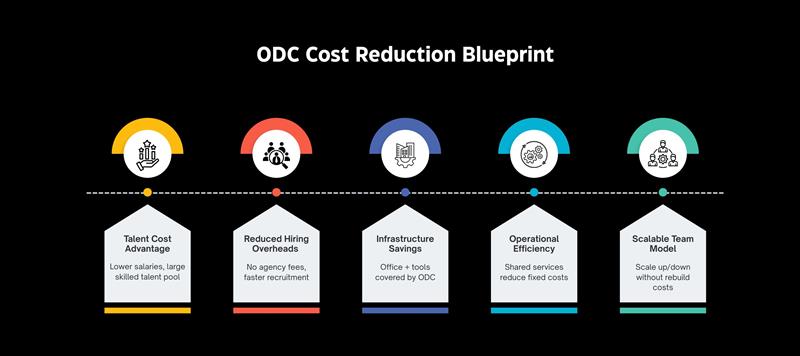
How Do ODCs Cut the Cost of Development?
1) Talent Cost Arbitrage.
Salary differentials are the largest lever on their own. The median senior engineering and management compensation in the US is still several times more than in key offshore centers; median engineering manager compensation in the US is potentially in the range of $200k, and in India the equivalent position is substantially less, which is an instant payroll saving when the position is offshored.
2) Reduce Hiring and Attrition Costs.
An ODC partner normally deals with the recruitment, background checks, onboarding and retention programmes. This saves on agency fees, reduces hiring duration and reduces the costs of repetitive training, which compounds in case of high headcount churn.
3) The Expected Infrastructure and Common Services
ODCs provide office space, hardware, licences, HR, payroll and compliance as a predictable monthly payment, eliminating the spikes in capital spending and the surprise facilities payments.
4) Without Rebuilds, Scalability.
Owing to the stability and commitment of teams to the organisation, adding a new module or scaling down never results in the recruitment of new staff or a lengthy process of knowledge transfer.
5) Productivity Multipliers
Agile processes of the parent company are spurred by focused time-zone-aligned teams working with the parent company. In the long run, the decreased cycle time and rework become a great saving.
Cost Savings with an ODC.
Cost Component | In-House / Traditional | Offshore Development Center | Typical Savings |
Developer salary | High (e.g., US averages ~$110k+) | Lower (India averages often than $12k) | 40–70%* savings on payroll. |
Hiring & agency fees | Agency + long cycles | Partner-managed hiring | Moderate – accelerated fill, reduced agency bills. |
Infrastructure & tools | Rent, CapEx, licences | Included or leased | Major: Transforms CapEx into guesswork OpeX. |
Support functions | Internal HR/Payroll/Legal | Shared by ODC partner | Moderate: Gets rid of distinct teams. |
Attrition & retraining | High, costly | Lower (dedicated teams) | Indirect but large over time |
Percentage ranges are role mix and location dependent; they should always be checked with a sample cost model.
Economic Benefits
In addition to the short-term savings, ODCs benefit the economy in more general ways:
They provide access to massive sources of talent (technology ecosystems keep growing in India with increased exports), better business continuity due to geographic diversification, and the capacity to use savings to invest in product R&D and go-to-market.
Investments in data centre and AI infrastructure at the national level enhance hosting and talent to undertake offshore operations.
When to Choose an ODC ?
ODC is also best suited for cases where a firm requires ongoing development capacity (not single projects) and in situations where they want to maintain control of IP and products, as well as being a low-cost offshore development path that can be scaled. It is applicable to product companies, SaaS businesses and businesses that are developing long-term platforms.
Conclusion
Futuristic and Realistic Conclusion