
The year 2025 is presenting an imperative of turning strategy into measurable value at a faster rate with few surprises and reduced cost to the companies. The market indicators are evident by the fact that the project management software and services ecosystem is growing at an alarming rate (project management software markets are measured in the single-digit to double-digit billions and beyond), and AI-powered project tools are seeing a shift toward production.
The 2025 project management consulting (PMC) is not about checklists or Gantt charts. It is a strategic field that aids in aligning people, technology, and investments so that teams and boards can fully realise the benefits of their work. Organisations that use fit-for-purpose delivery models, train teams, and integrate value-orientated governance greatly improve project performance, according to recent PMI studies. This is a real, quantifiable advantage during a time when investors demand transparency and speed.
What Contemporary PMC Does
Today, project strategy consulting transforms the priorities of the corporate into a prioritised portfolio of work, uses data and AI to predict risks, and develops operating models that allow hybrid teams to work reliably. PMC emerges as an ability: a transient or permanent expansion of leadership which shapes the outcomes, not deliverables.
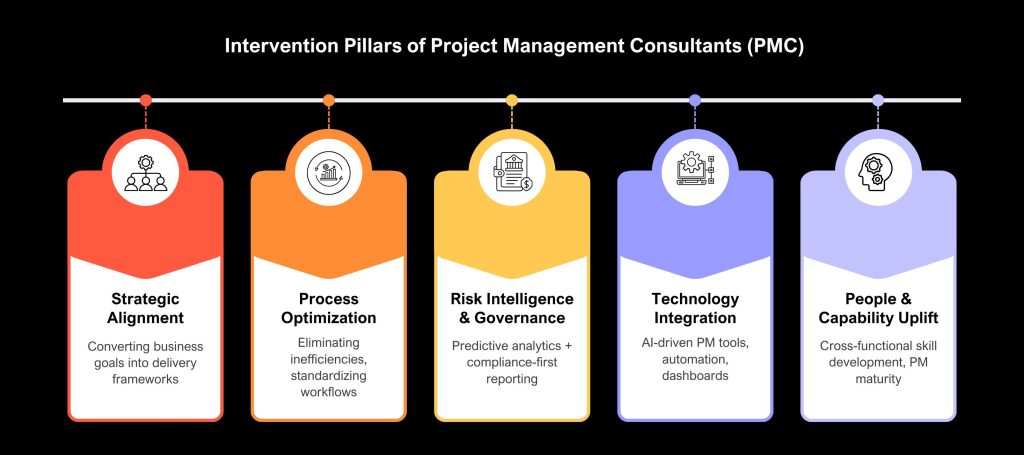
How PMC Transforms Business Performance.
- Portfolio discipline and strategic alignment.
PMC substitutes the ad hoc effort with a prioritised portfolio that is linked with the strategic KPIs. This saves on energy wastage and diverts capital to high-value programmes. Board members are provided with a holistic perspective of value delivery as opposed to project narratives. - More Expedited, evidence-based execution.
Predictive analytics and modern PM tools enhance forecasting, automate the status reporting and identify resource bottlenecks before they turn into crises; AI does. The outcome: increased on-time and on-value delivery, as well as reduced rework. The speed at which the AI-in-PM market is growing, which explains the reason why the consultancies are integrating predictive engines into the PMO practices. - Effective Governance by doing fewer meetings.
PMC is a contemporary approach to control that replaces inertia with lightweight escalation paths, KPI results, and continuous risk scoring. Businesses that adopt flexible delivery and upskilling programmes see a notable percentage increase in project performance, according to PMI research. - Economic benefits and cost optimisation.
PMC brings about resource modelling, vendor optimisation and benefits-realisation tracking. Silos cause duplication and hinder the ability to negotiate with vendors and to continuously measure ROI: running projects as a portfolio yields companies better economic results than siloed execution. The growth of the market in project-management services is another indication of growing corporate readiness to invest in such efficiencies. - Empowerment and embracing change within the employees.
Tools do not lead to failure of implementation, but human beings do. PMC couples technical delivery with targeted change programmes, overcoming adoption and entrenching new processes to make transformation stick.
A Brief Comparison Table
Area | Typical Outcome Without PMC | With Project Management Consulting (2025 model) |
Strategy execution | Fragmented initiatives, unclear ROI | Priority portfolio, KPI outcomes. |
Visibility | Infrequent, manual status reports | Live dashboards and artificial intelligence risk scoring. |
Delivery speed | Frequent delays, rework | Obligatory, anticipatory analytics-driven delivery. |
Cost control | Budget overruns common | Foreseeable budgets, vendor optimisation. |
Adoption | Low change uptake | Structured change + training = higher adoption |
Business impact | Hard-to-prove value | Real-time tracking of benefits, quantifiable ROI. |
Brief Industry Applications
- BFSI: PMC controls cloud-native core transformations, reducing regulatory drag and enhancing the time to market of digital services.
- Manufacturing: PMC coordinates the rollout of smart factories, integrating OT/IT, minimising downtime and accelerating the benefits of automation.
- Retail: PMC moves towards conducting omnichannel integration, which ensures inventory, logistics and digital experiences provide a single customer truth.
Future Outlook
Project management consulting will be more and more AI-native: Autonomous risk engines, marketplaces of skills that automatically allocate people by micro-competency, and digital twins that can simulate the result of programmes prior to launch.
Companies that are ready to give up time and cost assurance in favour of result-based business structures will achieve longevity contracts. This change and the increase in the economic rationale of external PMC skills are outlined by the growth path of the project management software and AI market.
Conclusion
Project management consulting is the key that connects strategy and realised value to leaders who are interested in business performance improvement in 2025. A contemporary PMC collaborator is characterised through portfolio discipline, AI-based intelligence, governance discipline and change expertise, which are necessary to hasten value creation, lessen waste and open quantifiable economic benefit. Unless the next change in your organisation needs to provide and maintain results, PMC should be considered as an investment rather than a delivery consideration.